Archive for "Travel Advice"
Planning a trip to Italy? Browse and read our useful and informative articles about the endless range of attractions and experiences in this lovely country.
Travel through the beauties of Italy with us. Visit our blog!
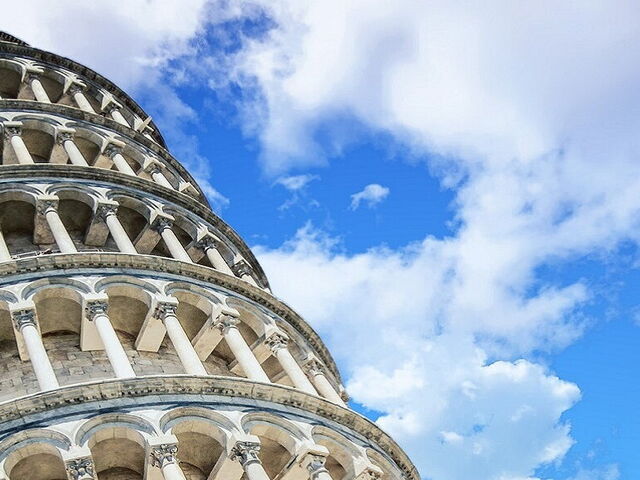
The Tower of Pisa is a monument that everybody is able to recognize seeing a picture of it. Along with the Colosseum, it is one of Italy's symbols and it appears in the "New 7 Wonders of The World” list because of its incredible beauty. This white leaning tower that seems to fall to the ground at any moment is located in Piazza dei Miracoli, next to the famous Cathedral of Santa Maria Assunta, to the Baptistry and to the Camposanto.
If you are staying in Tuscany, you cannot miss the occasion to visit this unique place!
What about its history?
The construction was started in 1173 by architect Diotisalvi, who also designed the Baptistry. However, the work was not carried out before 1350 because of the various delays and problems that emerged. The building reached a 56 m height and it arose next to the Cathedral, as it was its bell tower. In fact, the tower's interior is formed by two halls called "Sala del Pesce", as it contains a low relief representing a fish, and a bell room including seven ancient bells. The exterior is decorated with eight floors of loggias with columns and blind arches, built using the white marble of Carrara.
But why does the Leaning Tower...lean?
What makes this monument unique is its inclination. Is it an architectural virtuosity or a simple human mistake?
Actually, the correct answer is the second one. The soil under this heavy construction was sandy, clayish and not solid enough to support it, so the tower started to sink. This is why the works have been suspended over and over again and the attempts to solve the issue were vain. The 19th and 20th century restoration works did nothing but worsen the situation, which was finally stabilized in 1999-2001.
This “tower that leans and leans but will never come down" is one of the most visited Italian monuments: book your ticket and visit it during your next stay in Pisa!
The entrance ticket costs 18€ and online booking costs €10. You will have the opportunity to enter this beautiful building, to climb its 300 steps staircase and to admire a spectacular panorama from its top!
Are you looking for a holiday rental in Pisa? Choose one of our properties near this town and spend a dream holiday in Tuscany!
© Alice Pilastri
Read More

Famous museums, adventure parks, beautiful zoos, incredible swimming pools, dark caves to explore and many other amusements are what makes Tuscany a perfect region to choose to spend a vacation with children! The wonders of this region are hidden behind every corner and between its breathtaking landscape you will find some fantastic spots to visit with those you love the most.
Follow us in our journey across the best attractions for children in Tuscany, book one of our properties and start planning your holiday in the region!
1) The Beaches and Amazing Events of Versilia
The localities of Lido di Camaiore, Forte dei Marmi, Tonfano and Viareggio are all connected to each other with a comfortable bike path and with a pedestrian road, where kids can play and run in total freedom and safety. If the weather is hot, they will be welcome to play in one of the "Children Beaches" equipped with games right in front of the sea. Once you are here, do not forget to visit the famous "Cittadella" and "Museo del Carnevale" in Viareggio and take part to the magnificent Carnival parades taking place in February!
And where to sleep? Book our Villa Oliveta!
2) Pistoia: the Historical Center, Pinocchio's Park and the Zoo
As Pistoia offers innumerable activities to the youngest visitors, it has been awarded as a "children-friendly city" by UNICEF. Museums, theaters, natural parks, ancient palaces and the well-known "Giardino Volante" are some ideal places to visit with kids, as they mix their fun with learning. Other destinations for children are Pistoia's zoo, where they can meet giraffes, tigers and hundreds of other animals coming form all parts of the world, and the famous "Pinocchio's Park" in Collodi. In this incredible place created in honor of the cartoon character, children can see the real Gold Coin Tree, the Field of Miracles and the charming "Butterfly House”, inhabited by many colorful butterflies!
3) A Family Tour Inside Florence's Museums
Discover the splendid Florentine museums through some exciting interactive tours that will fascinate kids and adults! Palazzo Strozzi offers a guided "family tour", while Palazzo Vecchio organizes an itinerary called “vita di corte”, which is suitable for kids between 4-7 years old and includes some secret passages and hiding places. The treasures hidden inside the old town center can be unveiled with one of the "family tour" explorer's kits, which will turn your visit into an exciting treasure hunt along some of Italy's best roads. If you wish to visit some museums, we also recommend “Museo Galileo Galilei”, “Museo dei Ragazzi” in Palazzo Vecchio or “Bottega dei ragazzi” inside Istituto degli Innocenti, where you can enjoy some interesting tours!
4) Feel the Adrenalin in the Best Amusement Parks of Tuscany
Those who love fun and strong emotions will not be disappointed! Spend one day in “Cavallino Matto” park in Donoratico, which offers dozens of attractions, games and restaurants in a shadowy ambiance that adapts to the warmest days. In summer, do not forget to spend an afternoon inside one of the Acqua Villages located along the coast and enjoy their water slides and pools!
And where to sleep? Book our Villa Giulia Follonica!
5) Natural Parks and Adventure Trails
If you prefer to spend a day surrounded with nature dedicating to relax, we recommend visiting the beautiful “European Fauna Park” in Poppi, located between Arezzo and Florence, or to the magnificent "Il Gigante" adventure park in Vaglia (FI). here, right in the middle of a luxuriant wood, you will find a large area with seven paths for adults and children between the trees!
And where to sleep? Book our Casa La Fonte!
6) Discover Caves and Underground Tunnels
In Tuscany, there are more than 1500 caves and its underground tunnels extend for kilometers. Start your exploration and discover the hidden beauties on Elba Island, which is a perfect destination for holidays with kids and offers beautiful tunnels inside the "Parco Minerario dell’Isola D’Elba”. You can also visit Val di Cecina, where you will be surprised by the power of Earth watching its geysers! If you are staying in the province of Lucca, we also suggest visiting the splendid "Grotta del Vento” and the region of Antro del Corchia, which hides more than 60 kms of incredible underground paths.
And where to sleep? Book our Villa Il Nido!
7) Lucca: Bike Tours and "Lucca Comics and Games"
Lucca is a charming town to be visited riding a bike in total safety. Rent a tandem or a bike with child seat and ride along the road on top of the historical city walls with your children or visit the "Museo del Fumetto"! You can also participate to the amazing “Lucca Comics and Games” festival, which welcomes thousands of cosplayers and the best-loved movie characters: the atmosphere is special and the city gets very crowded!
And where to sleep? Book our Villa Flavia!
© Alice Pilastri
Read More
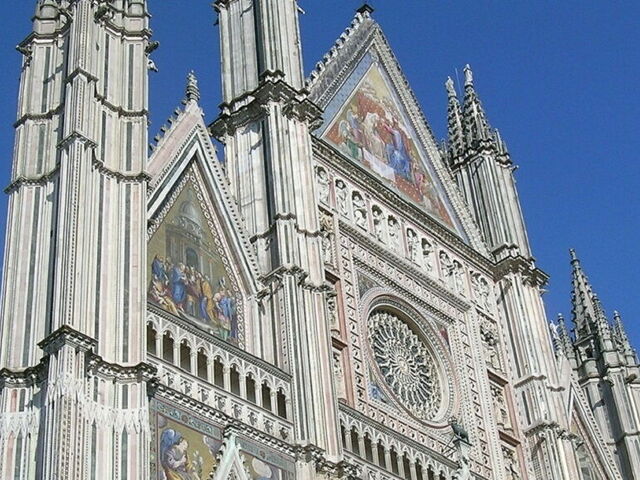
An ancient Italian saying goes “it's like Saint Patrick's well” to indicate an interminable challenging endeavor with no apparent logic. But does a well with this name really exist?
Yes, it actually does and it's located in Italy, in a splendid city in Umbria called Orvieto.
This architectural and urbanistic jewel in Alta Val Tiberina is situated between Latium, Umbria and Tuscany and it plunges its roots in mysterious ancient times. With its magnificent gothic Dome and its old town center castled on top of a hill dominating river Tiber, Orvieto has always represented an irresistible place to live in, especially for Etruscans. It has been an important commercial, artistic and military center and it is still considered a magic place by its inhabitants.
People believed that Orvieto was a sacred town, indissolubly linked to the element of water and to Earth's depths. This mysterious aura also encloses one of the most intriguing and significant monuments in Orvieto, Saint Patrick's Well.
Finished in 1537, the well was projected and built by Antonio da Sangallo il Giovane on order of Pope Clement VII, who had found shelter in Orvieto after the Sack of Rome (1527). The well had to provide water to Albornoz castle in case of siege, it was 62 meters deep and it presented two double-helical staircases which did not cross and could therefore accelerate water's transport.
But why is there a well named after Saint Patrick in Orvieto, as he spent his life in Ireland?
Actually, the legend tells that the Saint prayed near a deep cavern in Northern Ireland where he could get in contact with the afterworld. The cave was also called "Saint Patrick's Purgatory" and it was shut down by Alexander VI Borgia in 1457. However, its memory spread all over Christian Europe through the "Via Francigena", reaching cities like Orvieto. And it's here that a well was built almost one century later and where it also adopted a strong spiritual meaning.
Actually, climbing down its 248 stairway steps will make you reach Earth's depths surrounded by an Infernal unknown darkness after a strange “atonement process”. This mystic experience will end with water, symbol of purity and life and it will make you feel incredible emotions which cannot be described in words, but need to be lived in first person.
The tradition wants that whoever visits this well throws a coin in it, as it is believed that this action will help you to return to Orvieto once again.
Meanwhile, book now one of our properties near the city center to organize a wonderful vacation in thic locality! We recommend our Casale Porano!
Read More
The Gulf of Naples is studded with the so-called Phlegraean Islands of Ischia, Capri and Procida, which form an area full of suggestive landscapes and wonderful places to visit. The shimmering water glares and the luxuriant vegetation make the Neapolitan Archipelago one of the most beautiful regions of the world and a tourist destination for millions of people.
If you are staying in one of our properties in Naples or in Amalfi and Sorrento Coast, you cannot miss the opportunity to visit these splendid islands! Getting there is very easy: you will just need to buy a ticket and board one of the boats leaving from Pozzuoli or Naples to have a memorable day out.
PROCIDA
Procida is the smallest, purest and wildest island of the archipelago, where you will enjoy some time in touch with nature. It is connected through a tiny bridge to Vivara island, another little sea jewel which is safeguarded as a "Natural Archaeological Park".
Arriving at Procida, you will dive into a paradisiac and peculiar ambiance especially near the harbor: here, you will find lovely shops, restaurants and the typical colourful houses of a fishermen village. This tiny pearl with sandy coasts is a perfect summer destination thanks to some beautiful beaches like Pozzo Vecchio, Chiaia or Ciaiolella.
Live this special experience and get enchanted by the warm hospitality of its inhabitants and fishermen, who will be delighted to serve you some delicious fresh fish dishes during a romantic seafront dinner. Instead, if you'd prefer to get astonished in front of a spectacular panoramic view, hike “Terra Murata” promontory and look at the whole Neapolitan Gulf from the top! This fortified medieval center is very charming and its narrow streets conceal beauties such as the ancient Church of San Michele Arcangelo.
ISCHIA
The biggest island in front of Naples is Ischia, which is divided in six main centers and is visited by millions of tourists every year. The ”Green Island” of the Tyrrhenian Sea will surprise you with its stunning beauty and its beaches, which are nestled between high promontories and mountains like Monte Epomeo, an ancient volcano. It's actually the volcanic origin of the island that has made it one of Europe's most important thermal centers, with muds, fumaroles and healthy waters spilling from springs found everywhere.
Walk along one of the numerous tourist itineraries and visit Ischia city center, formed by dozens of streets, small stores and ancient churches like the "Cattedrale dell'Assunta", a 16th century basilica decorated with Giotto school frescos. Also visit the 474 BC "Castello, the "Santuario del Soccorso" in the charming center of Forio, Monte Sentinella astronomic observatory and Borgo Sant’Angelo. Here, in this tiny village in the southern part of the island, far from everything and everyone, is where you will enjoy some peace surrounded by some of the natural wonders offered by this small piece of heaven in the middle of the sea.
CAPRI
It is not easy to describe the beauty of Capri, as the emotion given by this island needs to be experienced in first person and cannot be understood through some simple words. Capri is Capri - few other places in the world succeed in emulating its poetry.
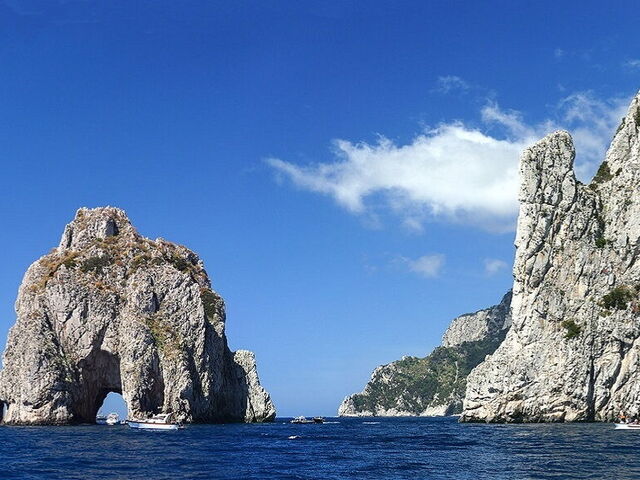
It's because of its calcareous origin that the island presents many steep rock walls, natural stone archs, calcareous cliffs, stone mountains like Pizzolungo and the famous sea stacks which represent Capri in the world. Other natural beauties are hidden between a cliff and the other: don't forget to visit the amazing Grotta Azzurra, an enchanting place with fantastic colors that conserves some Roman ruins, or the Belvedere di Tragara, a panoramic point where you will embrace the whole Gulf with a single glance.
The island is divided between the centers of Capri and Anacapri, where you will need to visit some interesting places like the 14th century "Certosa di San Giacomo", the "Eremo di Santa Maria di Cetrella" or the "Flowery Villas" like “Villa Jorvis”, which was chosen by Emperor Tiberius as his private residence.
It's impossible not to fall in love with the beauty of this locality, which has already charmed hundreds of writers, artists and poets in the past. Many couples choose Capri as their romantic travel destination, as they wish to admire the stunning panoramas at sunset and enjoy a seafront walk after a typical dinner in town.
What are you waiting for? Book one of our properties on the villas on the Amalfi Coast and live the holiday of your dreams in Campania!
© Alice Pilastri
Read More
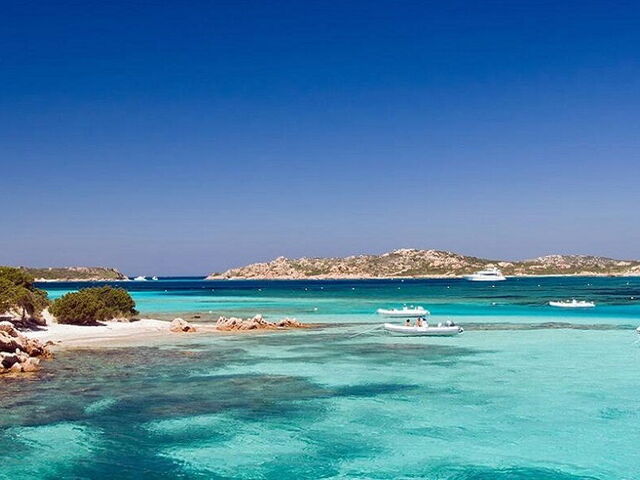
A wonderful destination for your next trip is certainly La Maddalena, the biggest of a 62-islands archipelago in Northern Sardinia formed by the well-known Budelli, Spargi, Santo Stefano, Razzoli and Caprera. La Maddalena is located right in front of Palau and of our charming Villa Sole tra i Ginepri, a luxury vacation rental on our website!
This 50 km² island presents sweet green hills and a jagged coastline with many coves and bays. The sea is transparent and there are innumerable natural beauties, more than 700 vegetal species and a rich marine fauna. The park authority safeguards this environment and it doesn’t allow the access to some splendid beaches to protect them, like the “Spiaggia Rosa” (Pink Beach) on Budelli island. Here, tourists used to take the pink sand home and this magic environment was risking permanent damages. Visitors can still visit beautiful beaches such as Bassa Trinita, Splamatore, Abbatoggia, Punta Tegge, Cala di Testa del Polpo beaches and the “Spiaggia del Relitto”, where a boat bobbed after a fire.
The must-see places are numerous: we suggest spending a day visiting the Compendio Garibaldino and the Memoriale Garibaldi on Caprera island, where Giuseppe Garibaldi arrived in 1857 and decided to spend the last years of his life. You can visit the barn, the private house and the spot where he and his daughters were buried. Furthermore, these islands offer an interesting museum tour between the “Museo Diocesano”, the “Museo del Mare” and “Museo Geomineralogico”, as well as a lot of sea and land summer excursions.
The first settlements on La Maddalena island date back to Neolithic Age but it was abandoned until the 18th century, when it became an important military objective because of its strategic position. This is why many defensive (like the “Forte San Vittorio”) and mimetic buildings were erected, in order to protect the island from sea and the following 20th century air attacks. Dedicate a day of your stay to the visit to granite quarries as well, where a high-quality granite is extracted and used to make famous sculptures, like Suez Canal Monument.
La Maddalena guarantees a holiday of relax, natural beauties and even a lot of fun. La Maddalena city center truly offers many entertainments to its visitors, with dozens of cafés, fish restaurants, clubs and shops.
To get to this island, you’ll need to board a ship in Palau and, once you’ll arrive, the splendid panoramas and maritime landscapes will certainly make your stay unforgettable!
Read More
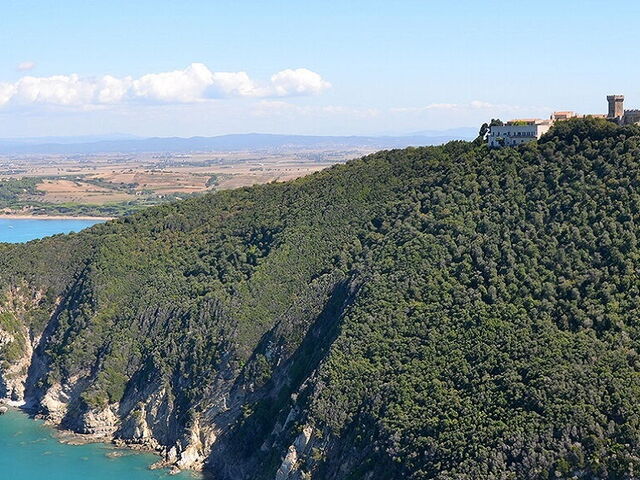
Tuscany is a region of a thousand beauties with some amazing beaches, especially in the area near Livorno and Grosseto. One of these is certainly found in the Gulf of Baratti, near the city of Piombino. This strip of sand separates a crystalline sea and a verdant promontory and it has a peculiar reddish color, due to the presence of iron minerals in the soil. It's the perfect destination for families with kids, couples, groups of friends and even for animals, as their admitted in a small trait of the beach. The water is transparent, the sea bottom is shallow and the surrounding panorama is breathtaking.
Actually, Baratty is not only famous for its beach, but also for its thousand-year old history linked to Etruscan civilization. The close center of Populonia became one of Etruria's most important centers between IX and VI century BC. The proximity to the sea was fundamental to undertake a commercial activity based on metalworking. Later, Populonia allied with Rome and therefore there are many architectural remains attesting its influence, like ruins of mines, industrial sections and necropolises.
Many of these graves are located in the "Parco Archeologico di Baratti e Populonia", an area of 80 hectares reachable through the path of Via delle Cave. Inside it, you will find ancient necropolises like those of San Cerbone, Casone or Poggio alla Porcareccia, dating back to VII-VI century BC. Noble families were buried all together in monumental tombs called “a tumulo” or “a edicola”, looking like small temples and internally decorated. On the other hand, a humblest and simplest type of tomb is “a sarcofago” or “a cassone”, which is individual and not decorated. Outside the park, you will find other ancient necropolises dating back to Villanovan period (IX-VIII century BC), like the one in "Buca delle Fate" or the necropolis of "Le Grotte", dug in sandstone.
So here's another stop of your journey across Tuscany, an ideal place to visit during your summer holiday! If you are looking for a vacation rental near Baratti, check out our luxury properties, like “Castello Leopoldo”!
Read More
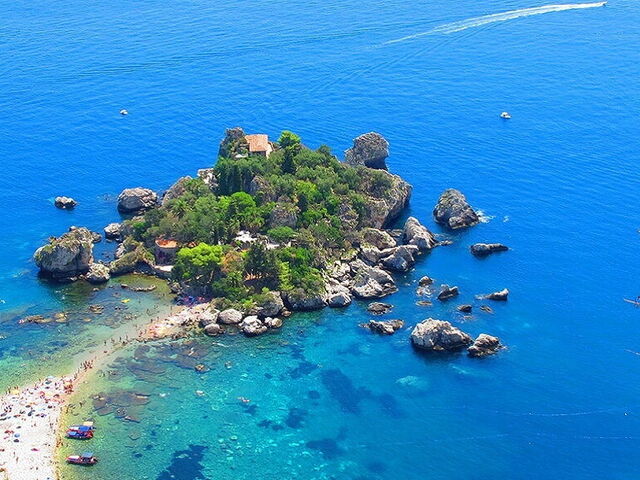
Sicily is an emerged paradise from the Mediterranean Sea which shines with its numerous beauties. Palermo, Siracusa (which is the topic of one of our blog articles) or Agrigento are just some of the marvels you need to visit during your stay on the island. A part that you cannot miss to see is the region with Taormina and Giardini Naxos, in the province of Messina.
Taormina is a small but characteristic city on the coast in front of the Ionian Sea. It was founded in the archaic age and it was inhabited by various nations like Greeks, Romans, Arabs, Siculans and Normans. The fusion between different arts and cultures created a magic place, full of ancient buildings which are visited and appreciated by thousands of tourists. The best-known one is the Greek Theater, built in the III century BC by Greeks and renewed by Romans. This enormous and magnificent open space was used for dramas and plays during its Greek period, while Romans transformed it into an arena for gladiators’ fights or naval battles. It is the second biggest Greek theater in Sicily after the one in Siracusa and today it hosts suggestive music shows or important international events such as G7.
Taormina’s old town center is formed by hundreds of narrow streets with panoramic sea views. You can even enjoy the panorama on “Isola Bella”, a wonderful island linked to the city with a sand strip which disappears with high-tide. The rich vegetation, the transparent sea and the stunning “Grotta Blu” make this island a mandatory step of your visit! On the other hand, in the city center you will find other important ancient buildings like the “Neumachia” (a century-old Roman architecture), the 13th century Church-Dome, Casa Cuseni and the “Villa Comunale”, known for its beautiful garden. You also have to visit the amazing beaches, like Mazzarò, Spisone, Villagonia or those on the “Isola Bella”.
Even Giardini Naxos is a fascinating locality in Sicily located few kilometers away from Taormina. It’s the perfect destination for those who want a holiday of relax, culture and fun, as here you will find dozens of restaurants, pubs, nightclubs and cafés. Visit Alcantara waterfalls, the Medieval Schisò castle, the Archaeological Park and Museum, which contains many ancient findings. If you look for a beautiful beach to go to, we suggest Recanati, Schisò, San Giovanni or Porticciolo Saia.
The local specialties which will accompany you are numerous: taste the typical chocolate “granita”, the “brioche con cappello”, the delicious ice-creams, the “pasta alla norma” or a fish dish!
In order to enjoy your holiday to the fullest, we recommend participating to an important event like “Taormina Arte” or “Taormina Film Festival” and to book one of our luxury properties. Choose between “Taormina Suite”, “Villa la Boheme” and “Torre Isola Bella”!
Read More
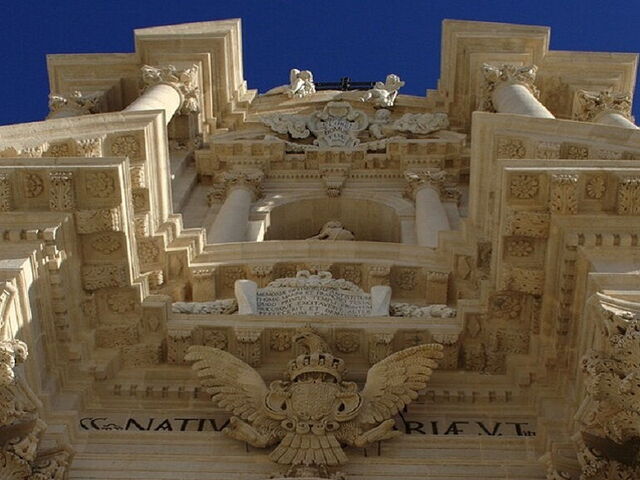
Syracuse is one of the most beautiful Sicilian cities, also famous for having a century-old history, a great artistic and archaeological heritage and for the stunning blue sea that distinguishes this Italian island. It was already a settlement during the Neolithic period, it hosted one of the oldest Christian communities and it has been occupied by Corinthians, Siculians and Arabs over the centuries. Since 2005, it is considered a UNESCO World Heritage Site and the presence of different kinds of ancient architectures in the same place contributed in transforming the city into a real Mediterranean jewel and an acclaimed touristic destination.
Here's a list of the spots you absolutely have to see in this wonderful city: don't forget to check our properties near Syracuse to choose the best accommodation for you stay!
• Madonna delle Lacrime Sanctuary
The building stands out from the other town center houses and it's visible from afar thanks to its 74 m height. It is considered a must-see in Syracuse by all its visitors and it was built in the 1960s after the lacrimation miracle of a chalk Madonna sculpture inside the church. Its dome has a peculiar aspect and if it's observed looking upward from the center of the building it is able to give a special sensation.
• Neapolis Archaelogical Park
This archaelogical park contains one of the biggest and best conserved Greek theaters (where it's possible to spectate to the acting of some classical Greek tragedies), a Roman amphiteater, the Altar of Lerone, the Latomie stone quarries and the "Ear of Dionysus", which is an artificial grotto linked to a famous legend. Visiting this place is like travelling through time: it's someting you really don't want to miss!
• The Catacombs of San Giovanni
Syracuse conceals the largest Italian catacombs after those in Rome, built by one of the first Christian communities of the Mediterranean. Explore the labyrinthine tunnels looking for the spot where it is believed that St. Paul preached to Sicilians!
•Ortigia>
Ortigia is the small old town center on a little island. Its narrow streets are overflown with people, typical local markets, delicious fish restaurants and many small shops. Its charm lies on the myriad of temples, castles and hidden churches, like the majestic Dome built over an ancient Greek temple. Walking along the seaside, you'll get to the Aretusa terrace, where an amazing panorama will take your breath away. Even the Maniace Castle, the "Bagno Ebraico" and the "Ipogeo" are places you really need to see.
• River Ciane
Papyrus plants are not only in Egypt as in this area they grow naturally. I suggest you a boat ride over river Ciane, where you'll be surrounded by hundreds of these plants and you'll have an amazing time. A whole museum is dedicated to this material, which is also used by craftsmen as a support for their watercolour paintings.
• Museo Regionale Paolo Orsi
This archaelogical museum is the biggest one in Sicily. In its halls you'll admire hundreds of findings coming from Sicily's excavations and magnificent prehistoric, Roman and Greek masterpieces.
• Santa Lucia Church
"Santa Lucia" is the town patron saint, as she was born here. Many churches are dedicated to her and the most important one is the "Chiesa di Santa Lucia alla Badia", inside of which there is a Caravaggio's masterpiece: "The Burial of S. Lucia".
• The Necropolis of Pantalica
In Pantalica, a village near Syracuse, there is one of the most valuable prehistoric sites, dating back to the XIII century BC. The necropolis presents over 5000 stone graves and the "Prince Palace", called "Anaktoron", on the top of the hill.
• The Sea and the Beaches
Syracuse is not just art, history and architecture: it's also full of wonderful natural landscapes and marvels! If the weather allows it, go to the beaches of Syracuse, Arenella, Fontane Bianche, Terrauzza or Ognina and dive into the splendid water. Remember to visit the Plemmirio protected marine area: it really deserves a glimpse!
Read More
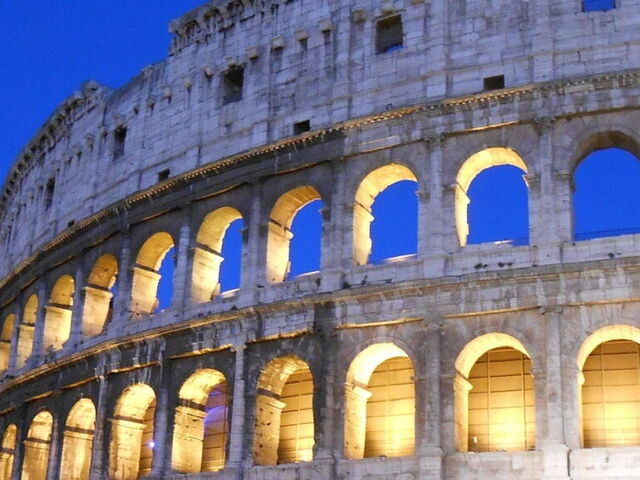
Which city is better than Rome, the Italian “big beauty” , to celebrate Saint Valentine’s Day or a romantic day out? The capital of love offers a fairytale atmosphere to all the couples who decide to spend here the day dedicated to lovers. A visit to its museums, to the Colosseum and to the Pantheon is certainly required, but there are other magic places where you must go to discover the hidden marvels of this city.
Here’s a top ten of the most romantic spots to see during your holiday in Rome: don’t forget to check our vacation rentals in town and choose the best for your stay!
1) IL PINCIO (Viale Gabriele D'Annunzio, 00187 Roma)
The Pincio is a beloved garden by Romans that was built at the beginning of the 19th century by Napoleon. Walk hand by hand along the historical promenade behind Villa Borghese and enjoy the amazing panorama over Piazza del Popolo from its terrace. This park has a neoclassical style, it’s particularly beautiful at sunset and it hides the famous water clock.
2) THE CAMPIDOGLIO (Piazza del Campidoglio, 00186 Roma)
The magic of this place is hidden behind the Palazzo del Campidoglio, along the road used by cars to reach the top of the hill. The view over the Fori Imperiali is especially breathtaking at night or sundown.
3) IL GIANICOLO (Via Garibaldi, 00165 Roma)
This hill was the place of the 1849 clash between the Roman Republic and the French and now it’s a public park dedicated to the Risorgimento period. A walk along via Garibaldi is something you cannot miss: hiking next to the symbolic monuments of the 19th century, you’ll get to the Trastevere, where you’ll be able to enjoy a romantic dinner.
4)AVENTINO AND THE GIARDINO DEGLI ARANCI (Via di Santa Sabina, 00153 Roma)
The garden has a spectacular and romantic atmosphere characterized by numerous bitter orange trees. The movie director Paolo Sorrentino chose it to film his “La Grande Bellezza” and the most magic place is certainly the main door of Piazza dei Cavalieri di Malta. Looking through its lock, you can observe Saint Peter’s Dome with a very unusual perspective. And don’t miss the panorama over the Tiber from its beautiful terrace!
5) THE ZODIACO (Viale del Parco Mellini, 88/92, 00136 Roma)
It’s one of the most famous belvedere of Rome and it’s on Monte Mario, the city’s highest point that offers an amazing panorama. Many lovers crowd the park and it’s perfect for a romantic promenade or an intimate dinner in a restaurant. Another good idea is a visit to the astronomical observatory of to spend a special evening together.
6) PARCO DELL’APPIA ANTICA (Via Appia Antica, 42, 00178 Roma)
The park is the ideal site to walk with your partner along the 16 km route near aqueducts, roman villas and other ancient ruins.
7) TRINITA DEI MONTI (Piazza della Trinità dei Monti, 3, 00187 Roma)
Trinità dei Monti is portrayed by thousands of postcards and it’s the symbol of Rome after the Colosseum. The stairway descending into Via della Condotta is frequented by a lot of couples, especially on late afternoons or evenings, when the light makes it even more wonderful.
8) FONTANA DEGLI INNAMORATI (Piazza di Trevi, 00187 Roma)
The famous Trevi Fountain is a special spot at night, when the square in less crowded and more intimate. You must throw a penny into the water and drink from the Fontana degli Innamorati next to it, as a belief says that the lovers who do this will love each other and will be faithful forever.
9) VILLA BORGHESE PARK
Villa Borghese Park is one of the biggest and best-known in the city. Discover its English and Italian-styled gardens, its columns, its villas, its ancient statues and its amazing lake, where you’ll be able to sail on one of its small wooden boats.
10) THE LUNGOTEVERE
The road running along the river has a unique beauty especially near the Isola Tiberina. The Ponte Milvio is a stop you must remember to do in order to add a love-lock to the hundreds left by other couples.
Read More
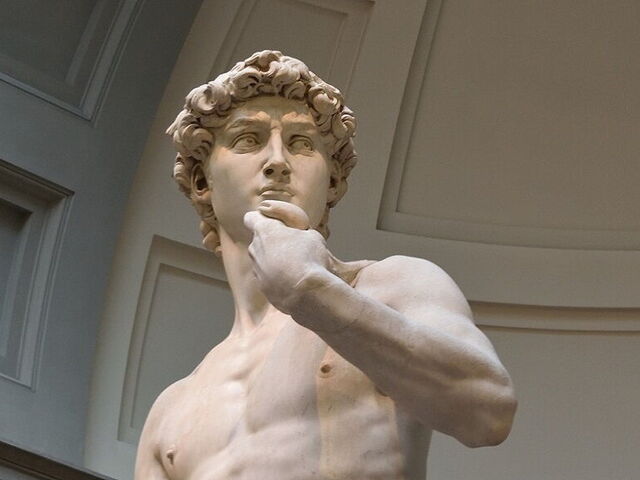
If you’re in Florence you cannot forget to visit the Galleria dell’Accademia before you leave it, as it’s one of its most important museums. The second most visited museum in Italy after the Uffizi conserves seven Michelangelo masterpieces, one of which is the unique David.
Its story began in 1784, when Granduke Pietro Leopoldo di Lorenza decided to reunite the “Accademia delle Belle Arti” with the “Accademia delle Arti del Disegno”, other institutions and a gallery where students would study, observe and copy the artworks inside it. Important masterpieces were placed in it, like the “The Rape of the Sabine Women” by Giambologna, the “Adoration of the Magi” by Gentile da Fabriano and the “The Madonna and Child with St. Anne” by Masolino and Masaccio. The Gallery was expanded between 1865 and 1971, when Florence became the capital of the Italian Reign, and it changed its name in “Galleria Antica e Moderna” becoming the first museum of contemporary arts in the new State. In 1872, the David sculpture was transferred in the museum from Piazza della Signoria as this place was too dangerous for a masterpiece like this. After the moving of numerous works of contemporary art like those of Botticelli or Beato Angelico, the museum had to change its name into “Galleria dell’Accademia” and it still conserves it nowadays. It is formed by several splendid halls which are the Hall of the Colossus, the Hall of the Prisoners, the Tribune, the “Gipsoteca Bartolini”, the Florentine Gothic room, the museum of musical instruments and the collection of Florentine works made between 1370 and 1430.
Book one of our properties in Florence and visit this wonderful museum! See our suggestions in Florence!
Tickets: full price, half price(for UE citizens between 18 and 25 years old and Italian school teachers) or free (for under-18s, disabled persons, ICOM members and journalists; the first Sunday of each month is free for everybody). I suggest you to buy your ticket in advance on internet or through the call center service paying an additional charge for the booking instead of spending 2 or 3 hours in the queue!
Opening hours: from 8:15am to 6:30 pm, from Tuesday to Sunday
Address: Via Ricasoli, 58-60, 50122 Florence
MICHELANGELO’S DAVID (1504)
The initial project intended to create some sculptures for the buttresses of the Dome of Florence and it was commissioned to Agostino di Duccio in 1463-4, who worked on an enormous block of marble. However, he didn’t finish it and the statue was left in the depository of the Museo dell’Opera del Duomo until 1500, when Michelangelo completed it. An art commission then gathered to decide its location: Botticelli suggested to put it next to the Dome, others in the courtyard of Palazzo Vecchio, Leonardo da Vinci proposed to hide it in the Loggia dei Lanzi, while Filippo Lippi and Pier Soderini preferred to put it in front of Palazzo Vecchio. In fact, here it would have acquired a symbolic meaning, as it referred to the civic virtues of the city of Florence. This was its final position, but it soon became the target of some stones thrown by pro-Medici citizens and it also broke its arm during a riot in 1527. The David is in the Tribune of the Galleria dell’Accademia since 1872, while a marble copy has been put in front of Palazzo Vecchio. The sculpture is 434 cm high and its position is similar to the classical “heroic nude” ancient statues. The proportional errors in the head and in the hands disappear when it is observed from a lowered point of view, as its original position had to be high on the buttresses. The work portrays David before he throws the rock against his enemy Goliath, he has wrinkled eyes which focus on his enemy and his pupils have been drilled to confer more intensity. Symbolically he represents the peak of divine creation, he’s physically perfect and he’s also the allegory of the victory of democracy over Medici’s tyranny in Florence.
Read More