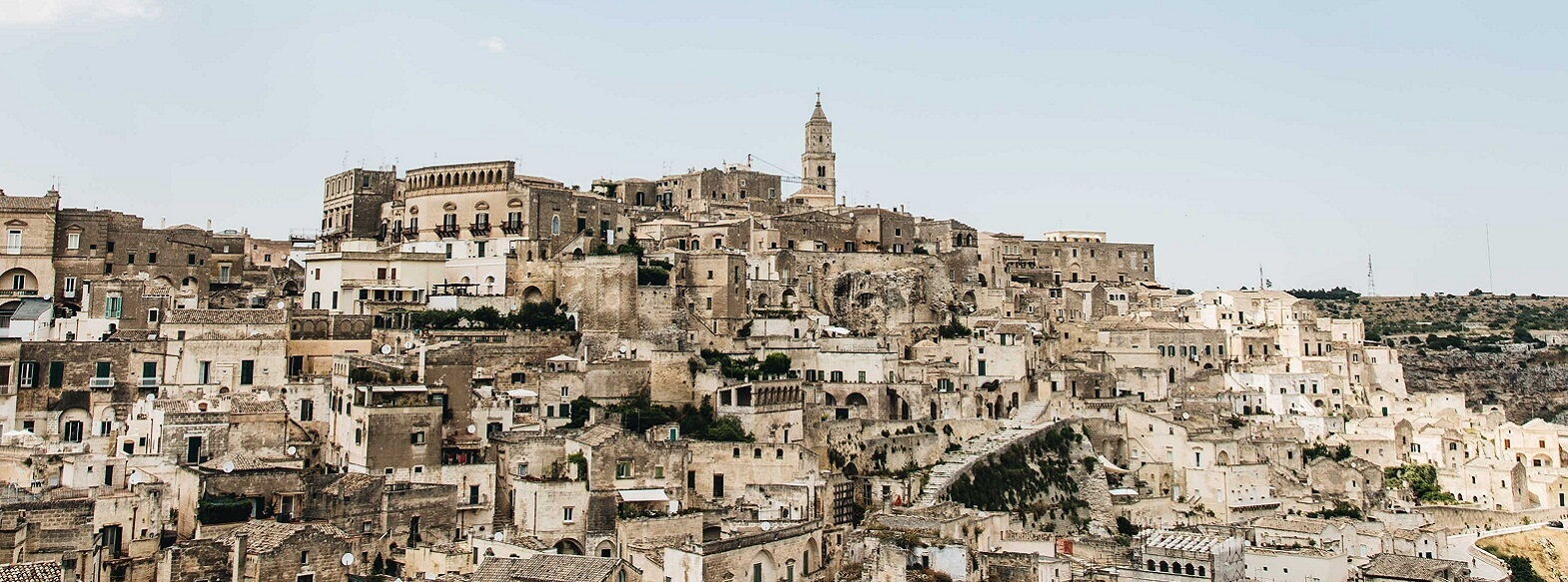
Some weeks ago I’ve been to Matera, a stunning city of Southern Italy in the region of Basilicata. Unesco awarded it as a “World Heritage Site” in 1993 because of the peculiar beauty of its “sassi” and it used the definition of “Cultural Landscape” for the first time. This city will also be the “European Capital of Culture” in 2019 and it will become the destination of thousands of tourists from all over the world!
The history of Matera is century-old and it started during the Paleolithic Age, whent the first inhabitants occupied the natural caves dug in the stone. More of them were added throughout the years, when man realized he could find shelter in the tuff stone excavating it. After overpassing the various pre-historical periods, Matera became a town of boundaries, contrasts and fusions between the different civilizations that dominated this area like the Byzantines, the Normans and the very important Christian populations.

Despite the historical changes, the famous Sassi have been inhabited ceaselessly. These houses have perfectly adapted to the natural context and men have discovered how to exploit the properties of their material and the constant internal temperature. Their structure is based on the superimposition of grottos, tunnels, houses, churches and gardens built in different epochs and they create a magic atmosphere with their dovetailing.
The Sassi are inserted in two huge natural amphitheaters called “Sasso Caveoso”and “Sasso Barisano”, which form the old town center with the “Civita” hill that divides them. The “Caveoso” is in the south, it presents many natural caves and it’s one of the richest Italian petroglyph heritages, while the “Barisano” is in the northern part and it’s mainly formed by excavated buildings.
Matera offers dozens of artistic and cultural events and the possibility to visit countless places of interest. An example is the wonderful Cathedral, built in 1270 in a Romanic style, or the “Parco Archeologico Storico Naturale delle Chiese Rupestri del Materano”, with several Paleolithic findings and churches like Santa Lucia delle Malve.
The uniqueness of its landscape has inspired some important writers like Carlo Levi, who wrote “Christ Stopped at Eboli” (1945) or film-directors like Mel Gibson, who filmed here his “Passion”(2004).
If you’re staying in Southern Italy or you’re looking for the ideal destination for a journey between natural, artistic and historical beauties, choose to visit Matera! Check our properties in Apulia, just a few kilometers away from the city!