

When we think about Apulia, we call to mind its sun, its splendid sea and its peculiar white buildings, the famous “Trulli”. It you visit this region, you cannot miss to visit Alberobello, the “capital of trulli” which has been awarded by Unesco as a “World Heritage Site”. This small center is almost completely made of trulli, which are white-grey cone-shaped stone buildings that follow one another along the streets. The atmosphere is really magic and fairy-tale. Some buildings have been transformed into restaurants, souvenir shops, private houses or even churches, like the Sant’Antonio “trullo-church”. The oldest buildings date back to the XIV century, when Robert of Anjou offered the land to the first Count of Conversano and the area got populated again.
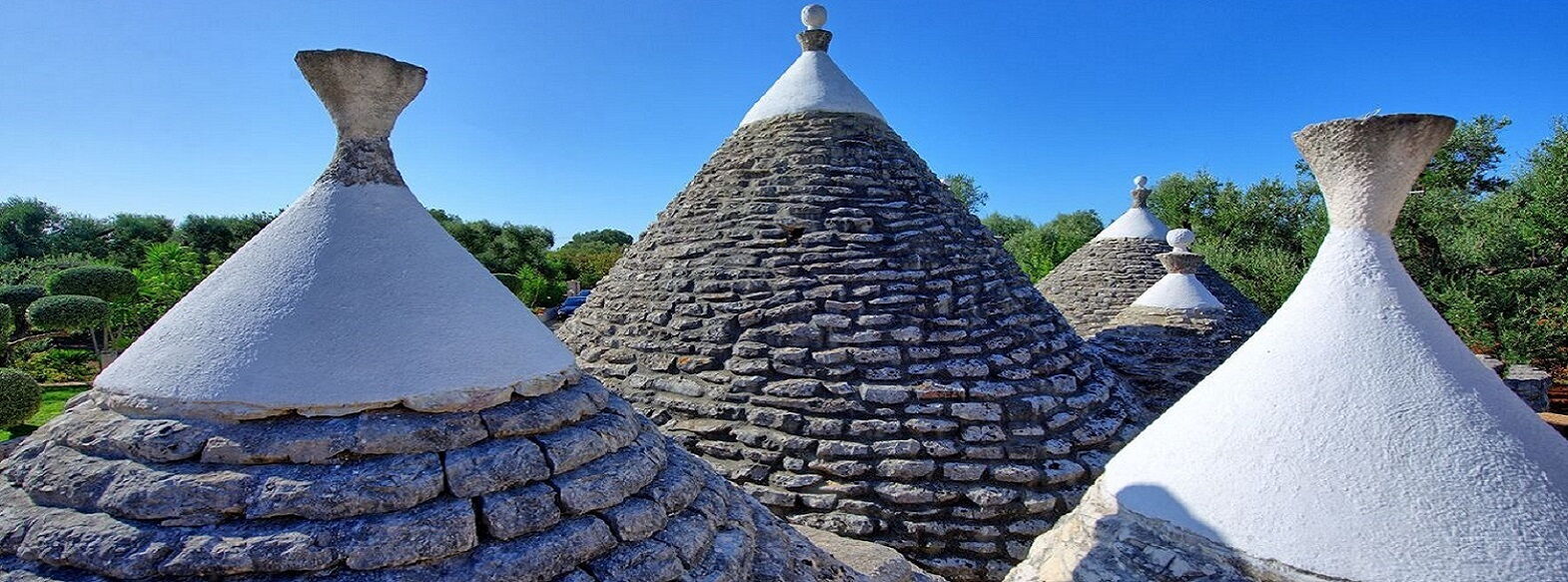
But what are the “trulli” and what’s their story?
These buildings are made of a typical Apulian material and they resume the prehistorical “tholos” model , the typical Mycenean 1500 BC grave. The first “trulli” were built by Apulian farmers with the rocks they found nearby in order to use them as temporary shelters or houses. Their dimension was initially small but it enlarged with the passing of time, until it included more than one room inside. The diffusion of “trulli” was due to the split of the feudal lands, as it was necessary to build new shelters for every farm in the countryside. Nowadays, the places with more “trulli” in them have turned into famous touristic destinations: further to Alberobello, don’t forget to visit Locorotondo, Cisternino, Martina Franca and Ceglie Messapica in the Valle d’Itria and the Altopiano della Murgia!
Some of these trulli have even been converted into wonderful properties where you can sleep for a few nights: it’s an unforgettable experience that you must have at least once in your life! Take a look at Trullo Oak or ”Trullo Santo Stefano”!