Archive for "Culture"
Planning a trip to Italy? Browse and read our useful and informative articles about the endless range of attractions and experiences in this lovely country.
Travel through the beauties of Italy with us. Visit our blog!
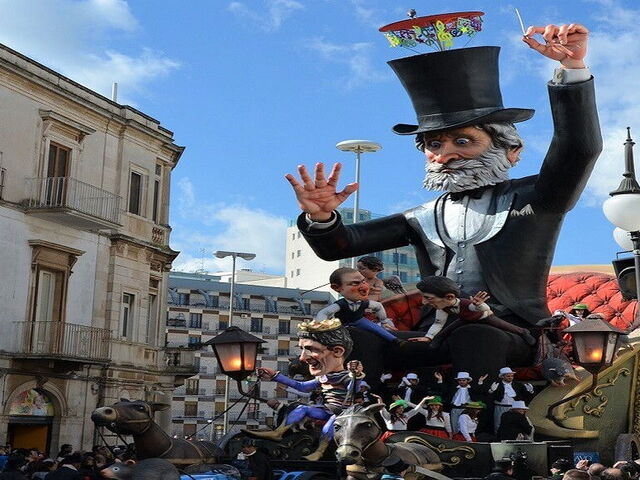
Did you know that the Putignano's Carnival festival is one of the oldest and longest in Europe? This year, the town celebrates the 626th edition and the theme is "The Earth seen from the Carnival".
If you are in Puglia, don't miss the opportunity to participate in this incredible event! Discover more about its history and find all the information you need to take part to it!
It all started way back in 1394, when Puglia was the aim of Saracen raids. To protect local treasures, some important objects, such as the relics of Saint Stefano in Monopoli, were brought to safety. The new destination was Putignano and the relics were transferred there on December 26, 1394. A legend tells that many peasants joined the religious procession singing festive, but also satirical songs. They abandoned their work in the fields to participate and they left the vines they were treating with a traditional offshoot technique.
This was, in fact, the beginning of "Festa delle Propaggini" (offshoot festival), which is still celebrated with passion after 626 years. Every December 26th, local poets recite their poems in the city's square, recounting the main events of the past year and ridiculing them in a satirical way. Actually, it is a challenge in vernacular language based on satire against local politicians: if you are in Puglia in late December, this is definitely an event you cannot miss!
"Festa delle Propaggini" officially kicks off the period of Carnival, which begins on January 17 with the Festival of Sant'Antonio Abate. Every Thursday, satirical shows are organized in the town and each one is aimed at a different objective. Monsignors, priests, nuns, widows, madmen, married women and cuckolds ... nobody is spared! The so-called "Festa dei Cornuti" (cuckold festival) is certainly the most fun: it begins with a procession at dawn where participants walk with large horns on their heads and it is followed by the proclamation of the "horned man of the year". In the evening, all the horns are cut to symbolize the erasure of the signs of betrayal. Another important date is the Bear Festival, celebrated on February 2, which is also the day of Candlemas.
The beautiful allegorical float parades take place every Sunday in February (9,16,23,25 and 29 February 2020). They include seven allegorical floats made by masters of papier-mâché, which represent facts of national and international importance in an ironic way. These works of art can also be admired with a closer look by visiting the sheds where they are created: it is a unique experience, suitable for the whole family! This year, the theme of the parade is the Earth, which must be protected through sustainable development and reducing environmental impact.
On the eve of Fat Tuesday, Putignano organizes another important procession attended by people dressed as priests, who impart extreme unction at the Carnival. Then, "his funeral" is celebrated on Shrove Tuesday evening: to symbolize the end of this period, a large papier-mâché pig is burned in the main square and the Maccheroni Bell rings 365 strokes to mark the beginning of Lent.
The typical mask of Putignano is Farinella , which takes its name from a product based on barley, chickpeas and salt cooked by farmers in this period.
What are you waiting for? Book a
Read More
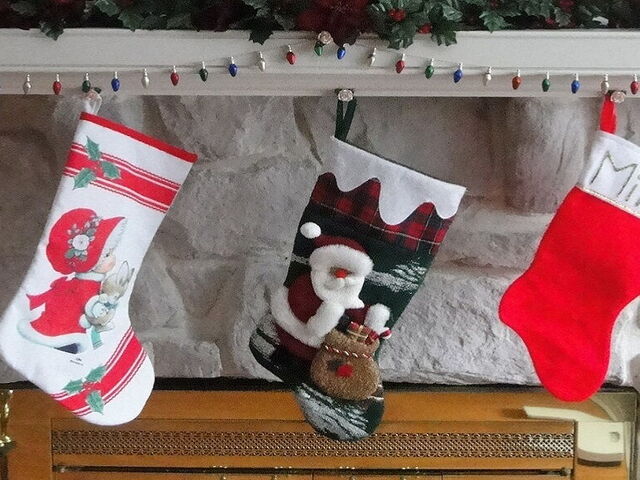
The word Epiphany literally means "revelation" and refers to the appearance of Christ to men through the Three Kings. So why do Italian children wait for the Befana to bring them chocolate and sweets on January 6th? What does an old lady who rides a broom mean?
Discover more about the history of Befana and all the unmissable events taking place around Italy to celebrate Epiphany!
According to a legend, the Three Wise Men on their way to Jesus's birthplace asked for information to an old woman, because they could not find the right path. To thank her for her help, they insisted to make her join their road, but she declined their invitation. However, the old woman soon repented bitterly of her decision and she quickly prepared a basket of sweets to bring to the newborn child. She went out to look for the three Men, but it was too late and she couldn't find them. So, she started knocking on the door of every house she found in search of Jesus, leaving sweets to every child she met hoping that he was Baby Jesus in person. And after more than two thousand years, that's what she's still doing!
On January 6th of each year, children sing a famous refrain waiting to receive sweets and other delights. The translation is: "The Befana comes at night with her shoes all broken, with the patches on her skirt: viva, viva the Befana!". This is how this old woman is represented by all kids. On the night between 5 and 6 January, she descends from the fireplace to fill the empty hanging socks left by children. The good ones will receive gifts and sweets, while the naughty will find some awful coal!
Each Italian region celebrates the Befana in a special way, organizing markets, traditional festivals and some typical auspicious stakes, as it represents that the past year is "burned" to make room to the new one.
In Tuscany, in the province of Grosseto, there is a group of boys called "befani", who accompany the old woman through the streets of the city singing some songs. In Florence, the so-called "Cavalcade of the Three Kings" is organized every year: this is a procession consisting of about 700 figures leaving from Piazza Pitti, crossing the entire historic center and arriving at the Baptistery, simulating the journey of the Wise Men to Bethlehem. Moving to Lucca and its surroundings, we suggest taking part to the Befana celebration in Barga, where Epiphany is deeply felt: the children disguised as a Befana move from house to house singing songs and finally gather around a bonfire forming a large circle. In the locality of Pegnana, there is also a small Befana house that can be visited at any time of the year.
In Liguria the Befana comes from the sea making every child very joyful, while the most famous Epiphany market in Lazio is located in Rome in Piazza Navona, where a Befana in person comes to greet the children among stalls full of sweets. The streets of Naples, on the other hand, are full of markets where you can buy sweets for stockings, especially in Piazza Mercato.
What do you eat on this special occasion? Tuscan tradition includes Cavallucci of Siena, which are soft biscuits made with water, sugar, honey, candied fruit, anise, nuts and yeast, as well as "Befanini", which are cookies coming from the Lucca area made with rhum and citrus fruits.
In Liguria, people prepare the "anicini" biscuits, usually eaten with a glass of sweet wine, and the donut of the Three Wise Men , a dessert covered with raisins, candied fruit and sugar. In the south of Italy, precisely in Campania, people prepare the first pastiera of the year and some delicious struffoli, which are small balls of sweet fried dough, dipped in honey and decorated with candied fruit and sugared almonds.
© Alice Pilastri
Read More
December 19, 2019
What to See in Pisa in a Day: 5 Unmissable Places for Your Tour
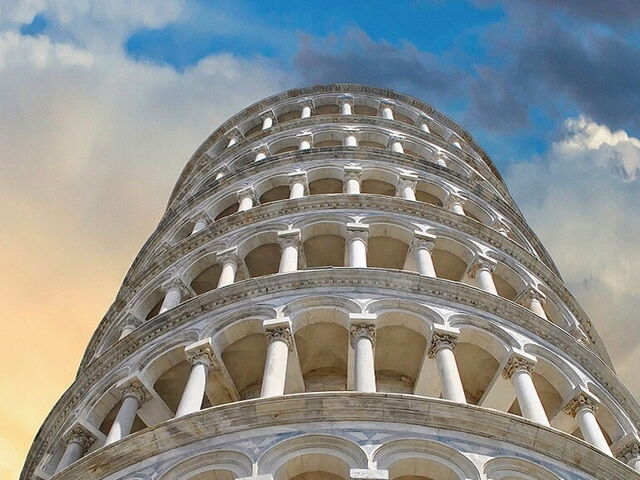
The name of Pisa has always been linked to the famous Leaning Tower, but the architectural beauty does not end there.
Discover the best attractions of the city and the things to see at all costs during a short and magnificent tour!
1. Piazza dei Miracoli
Your tour should absolutely start from Piazza dei Miracoli, a wonderful sqaure that owes its name to a novel by Gabriele D'Annunzio where the square is called "Prato dei Miracoli". Its surface is partly paved, while the rest is covered by a green lawn that also surrounds some of the greatest architectural masterpieces of all time.
The most important monument is the Leaning Tower, the symbol of the city of Pisa in the world. It was built in 1163 on a sandy bottom that did not hold the weight of the structure, so it immediately began to tilt. Likely, its designer was Diotisalvi, who also built another building in the Piazza. This is the gigantic Baptistery, which contains some splendid statues and an invaluable pulpit made by Nicola Pisano. Even this building had a difficult history: due to lack of money, the dome was made with different materials than the rest of the complex! The other great monument of Piazza dei Miracoli is the Cathedral of Santa Maria Maggiore, a Pisan Romanesque church dating back to the end of the 11th century. The facade has four orders of loggias, while the interior is divided into five naves. Among the most beautiful works located inside, it is necessary to mention the mosaic by Cimabue, the pulpit by Giovanni Pisano and the reproduction of the chandelier that inspired Galileo Galilei's theory of isochronism. Finally, you have to visit the last wonder of the square, called Camposanto Monumentale. In this sacred place, the Crusaders brought the land of Golgotha in ancient times. Nowadays, it hosts the burials of some illustrious Pisan personnalities and important works of art dating back to the Etruscan, Medieval or Roman periods.
If you have little time available and you can't get into all these buildings, don't worry: a simple walk around the Piazza is enough to admire its beauty and to take some amazing photos in front of the Tower!
2. Piazza dei Cavalieri
The name of this elegant square is given by the headquarters of the Knights of Santo Stefano located inside it. All the palaces overlooking the square conserve a unique charm, and these are the Rectory, the "Palazzo del Consiglio dei Dodici", the Church of Santo Stefano (built by Vasari) and that of San Rocco. The most famous palaces are certainly Palazzo Carovana, a splendid Renaissance building housing the exclusive "Scuola Normale Superiore", and Torre della Fame inside Palazzo dell'Orologio, which is the place where Count Ugolino della Gherardesca and his children died in 1289 according to Dante's story in the "Divine Comedy". The beauty of the square is enhanced by one last detail, namely the statue of Cosimo I de 'Medici in the role of Grand Master of the order of the Knights.
By day, Piazza dei Cavalieri is certainly the perfect place to take some photos and appreciate the beauty of the buildings, but at night it becomes one of the main places of Pisa's nightlife: don't miss it!
3. The historic center
The old town centre is not very large, so a few hours will be enough to see everything! Borgo Stretto is the best-known street, distinguished by the lovely arcades and Renaissance palaces. It also features Casino dei Nobili, a place where 18th century nobles went to have fun organizing parties, conversations and gambling. Instead, passing through Via delle Colonne you can reach Piazza delle Vettovaglie, an ancient food market that transforms into a lively location on Friday and Saturday nights. Admire the beauty of the center, taste some Pisan specialties in one of the restaurants and enjoy some shopping in the countless shops: you'll surely enjoy the best of this wonderful town!
4. Lungarno
One of the most beautiful areas of the city is definitely the Lungarno, the perfect place to take a walk or admire the view from a bridge. The so-called "Lungarno Mediceo" houses some important palaces such as Palazzo Toscanelli, Palazzo dei Medici or the Church of San Matteo in Soarta, while "Lungarno Gambacorti" presents the beautiful Church of Santa Maria della Spina, an architectural jewel of Gothic art that owes its name to the relic of a thorn from the crown of Christ.
5. Museum of Ancient Ships / Murals "Tuttomondo"
Do you love art and want to visit a nice museum? If you are interested in archeology, you cannot miss the "Museum of Ancient Ships" inside Medici Arsenals! These beautiful ancient ships were discovered in 1998 during some railway works, which brought to light about thirty Roman ships, their commercial loads and a series of priceless testimonies. If you prefer modern art, instead, don't forget to go to the Convent of the Servant Friars of Mary inside the Church of Sant'Antonio: you will be fascinated by the "Tuttomondo" mural created by Keith Haring!
Are you ready to start your amazing tour of Pisa?
Discover our selection of villas in Pisa and surroundings and start organizing your dream vacation !
© Alice Pilastri
Read More
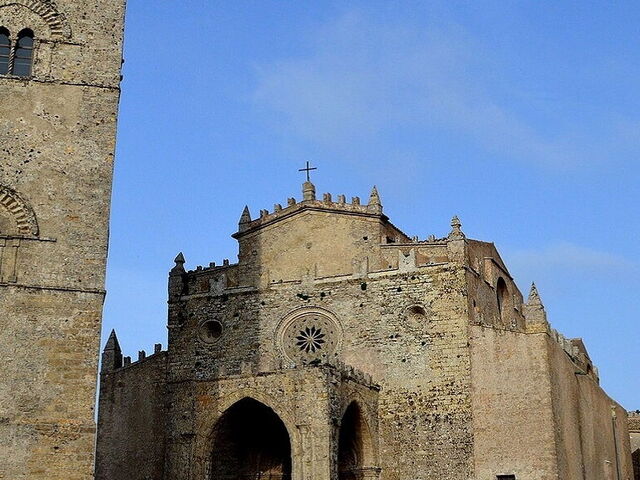
If you are visiting Sicily and the area of Trapani, you cannot miss going to the medieval village of Erice! This quaint town is perched on a mountain 750 meters high and dominates a truly breathtaking panorama. Together, the Gulf of Trapani, the famous salt pans, Egadi islands and the typical Valderice countryside create a wonderful landscape that leaves every visitor speechless.
There are many things that deserve to be seen in the center of Erice... are you sure you know them all? Discover the best attractions and places to visit during a wonderful tour and start organizing your trip!
The history of the village sinks into an ancient and controversial legend. In fact, it sometimes associates the founding of the city with Enea, then with Eraclea or Erice, and scholars are still trying to reconstruct its past. However, what is certain is that Erice was known because of a famous temple where the Phoenicians worshiped Astarte, the equivalent of the Greek goddess Aphrodite and the Roman goddess named Venus.
The best way to visit Erice is certainly walking through its narrow, paved streets. Passing among the small houses, the courtyards and the balconies of the historic center you will dip into a unique atmosphere that will stun you with its fantastic colors and scents!
The imposing City Walls that surround the old town date back to the 8th-6th century BC and are made with large limestone blocks. The best preserved section is the one located between Porta Carmine and Porta Spada. However, to enter the town we recommend crossing Porta Trapani: this door puts you in front of the marvellous Duomo and the effect is simply amazing! The city's cathedral is a fortress-church dating back to the 14th century with a tall bell tower. Although the beauty of this building is unique, the most famous palace in Erice is Castello di Venere, a fortress of Norman origin built on the remains of the temple dedicated to the goddess Venus. It is from this high cliff that you can admire a breathtaking view over the entire gulf, especially at sunset! Moreover, if you are lucky and the air is quite clear, you will even be able to see Pantelleria Island and the distant coasts of Tunisia. Not far from the castle, you will also find Villa Comunale Balio, a famous villa with splendid gardens, and other Norman watch towers that were restored by Count Pepoli. Among these, there is the wonderful Torretta Pepoli, a corner of study and meditation immersed in vegetation.
On another spur of rock located between the churches of Sant'Orsola and Sant'Antonio, you will find instead the unique Spanish Quarter, an imposing 18th century building that housed a garrison of Spanish soldiers but which has never been completed. It also offers an incredible view!
After walking around the center and climbing Mount Erice, you cannot miss a sample of some local delicacies! Don't miss to try the well-known Erices' patisserie, which offers sweets in almond paste and exquisite artisanal "cassate". Of course, a sweet shop you should visit is that of "Maria Grammatico", a city's symbol that offers all kinds of desserts! On the other hand, if you love shopping we advise you to go into some pottery or carpet shops. In Erice, carpets are called "trappite" and they are made by weaving the threads with recycled fabrics.
Do you still need to book your stay in Erice? Have a look at Villa Erice, Villa Bellini or Villa Salinella and start planning your amazing trip!
© Alice Pilastri
Read More
November 9, 2019
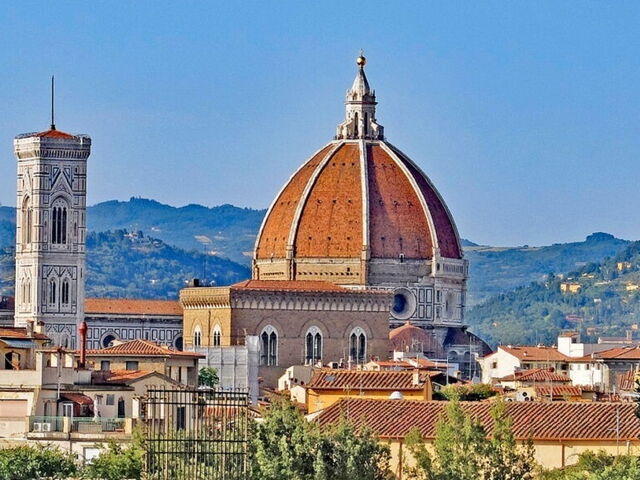
7 Stunning Churches to See and Visit in Florence
Is there a city as beautiful as Florence? The "birthplace of Renaissance" is a treasure trove of beauties and things to see are
endless. Among these, there are certainly many churches and cathedrals that deserve to be visited at least once in your lifetime. But how can you see them all in a few days? How can you choose the best ones to visit during your short stay?
We have selected the 7 most beautiful churches in the city to help you organize your next tour: discover them all and get ready to discover all the beauties of the center of Florence!
1- The Dome
The Cathedral of Santa Maria del Fiore was started by Arnolfo di Cambio in the 13th century, while the
Brunelleschi's dome was finished in the fifteenth century. The façade in white, pink and green marble is richly decorated and is a masterpiece of Italian Gothic style. Inside, the left nave hosts three 15th century frescoes made by Domenico da Michelino, Paolo
Uccello and Andrea del Castagno. The dome was frescoed by Vasari with scenes from the Last Judgment: there is nothing better than climbing the stairs inside the dome to admire them from a closer distance! Also, at the end of the numerous stairs you will be rewarded by a splendid panoramic view of the
whole city! Don't forget to visit the Baptistery of San Giovanni and the Campanile of
Giotto, which are two unmissable monuments right next to the Dome.
2- La Chiesa di Santa Maria Novella
This church is one of the most important Gothic churches in Tuscany. The façade is a beautiful work by Fra Jacopo Talenti and Leon Battista Alberti. Inside, you will see a magnificent Giotto crucifix, some frescoes
by Ghirlandaio and the famous "Trinità" by Masaccio. If you love Renaissance art, you can't skip this stage!
3- The Church of Santa Croce
The Church of Santa Croce is the burial place of many art, music,
literature and science personalities. Walking along the imposing white marble tombs, you will be overwhelmed reading important names like Machiavelli, Michelangelo, Galileo Galilei, Leon
Battista Alberti and Alfieri. The building was started at the end of the thirteenth century by Arnolfo di Cambio, but the facade remained unfinished
until the nineteenth century, when it was completed using polychrome marble and reproducing the typical Florentine Gothic style. In addition to the famous tombs, the interior of the church houses some frescoes by Giotto and Gaddi, as well as a beautiful crucifix by Donatello. The visit does not end here: you can also visit the cloisters built by Arnolfo di Cambio and Brunelleschi, along with the wonderful Cappella de 'Pazzi decorated by Luca della Robbia and Giuliano
from Maiano. Finally, you will be able to see works such as the Cimabue crucifix inside the Museo dell'Opera. It's a fantastic stop of your tour!
4- The Church of Orsanmichele
The name of this church derives from the union between the names of "San Michele Arcangelo" oratory and the garden from which it was surrounded. In ancient times, there was a building called "Loggia del Grano" (wheat's market) located at the church's place. Actually, you can still spot the drawings of the ancient units of measure and the corridors that connected the warehouses to the market! What immediately catches one's eye in Orsanmichele arecertainly the tabernacles on the façade, decorated by the "Florentine arts" and depicting the patron saint of each guild. They were made by splendid artists such as Donatello, Ghiberti and Brunelleschi!
5- The Church of Santo Spirito
This church is hidden among the houses on the other side of the Arno river and it presents a very simple look. The original building dates back to the Renaissance, but the interior part was made in the Baroque age. Here, you can find some important works, such as the "Pala Nerli" by Filippino Lippi or a wooden crucifix carved by Michelangelo. The square in front of the church is always lively and crowded, as this is one of Florentine nightlife's main locations!
6- The Church of San Miniato al Monte
The charm of Piazzale Michelangelo is unique and its splendid church makes this place even more splendid! The Cathedral of San Miniato is located in the upper part of the city and is a perfect example of Italian Romanesque style. It presents
a splendid entrance stairway and a magnificent mosaic with a golden background, depicting Christ in
throne. It is one of the most romantic places in the city, where you can enjoy a unique view of the entire center! Don't forget to visit the crypt frescoed by Taddeo Gaddi and the Monumental Cemetery, which is a panoramic location containing tombs of illustrious characters such as Montale, Villari or Stibbert.
7- The Church of San Lorenzo
San Lorenzo is perhaps the oldest church of Florence... however, its facade is still unfinished! Its three naves
contain magnificent works by Bronzino, Rosso Fiorentino and Donatello, while the Old and the New Sacristy are two splendid chapels that will leave you breathless. Built by Brunelleschi, they house some tombs of the Medici family and Michelangelo's sculptural decorations. Don't miss them!
Looking for a vacation rental in Florence? Discover about Villa Le Fonti and Villa Ancora, some wonderful properties in the city's surroundings!
© Alice Pilastri
Read More
November 5, 2019
Siena: 7 Beautiful Things to See During a Perfect City Tour
A visit to Siena is like a beautiful journey through time: walking among historic buildings, churches and ancient buildings, you will feel like taking a dip in the Middle Ages! This beautiful center is one of UNESCO World Heritage Sites and it can be consederd as one of the most beautiful in Italy, as well as in the whole world.
Have you planned a trip to Siena? Get ready to see its top attractions during your tour! Discover 7 wonderful things to see in this city to organize a perfect tour!
1- Piazza del Campo
The first stop on a trip to Siena is certainly Piazza del Campo, a world-famous square, known for the Palio (discover more about this event!) that is run twice a year, on July 2nd and August 16th. The square presents a shell-shape divided into nine segments, as it refers to the "Government of the Nine" that administered the city in the fourteenth century. It also includes a fountain called Fonte Gaia, one of the most important monumental fountains of the city. Piazza del Campo is located in a neutral territory and it is considered part of a common heritage of all the city "contradas". Actually, the Palio is particularly felt in Siena and it ignites great rivalries between its districts!
2- Palazzo Pubblico
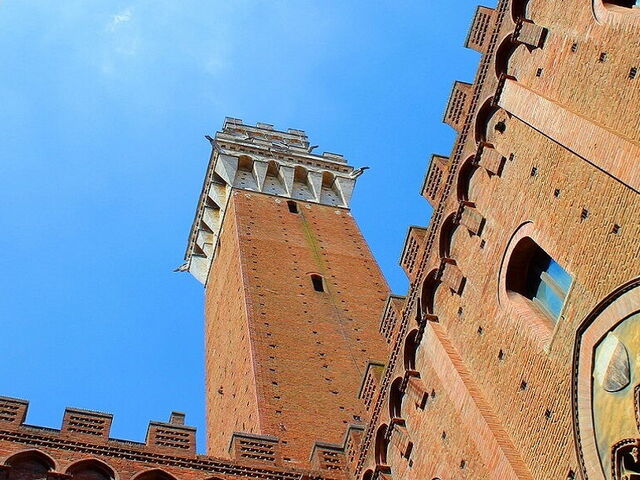
Overlooking Piazza del Campo, the wonderful Palazzo Pubblico housed the Government centuries ago. It is a Gothic-style palace with mullioned windows, three-light windows, arches and richly decorated facades. Its interiors host the Civic Museum, which is an exhibition space containg the famous fresco by Lorenzetti, called the "Allegory of Good and Bad Government". Yo can also climb the beautiful "Torre del Mangia", a bell tower built in 1338 that is also one of the highest towers in Italy!
3- The Dome and its Monumental Complex
The Cathedral dedicated to Maria Assunta is an architectural masterpiece. Its façade is made in white marble and it's decorated with inserts in green and red marbles. It houses some works by Donatello and Michelangelo, as well as a majestic pulpit by Nicola Pisano. However, the floor is the part that always surprises the most: the fifty-six scenes inlaid in marble have been made by important artists of the fourteenth century and they leave every visitor speechless! However, the Cathedral complex does not only include the Dome: in addition to the Piccolomini Library frescoed by Pinturicchio, there is a magnificent crypt, the Museum of the Opera del Duomo and the Baptistery of San Giovanni. This last presents a charming marble baptismal font made by Jacopo della Quercia, which shows some splendid bronze panels made by Ghiberti and Donatello.
4- The Museum Complex of Santa Maria della Scala
Right next to the Cathedral stairway, you'll find a magnificent complex with works of art covering a period of a thousand years. Now it is an important museum, but in the medieval period this building was a hospital for pilgrims from the Via Francigena ! Precisely for this reason, one of its most beautiful rooms is called "Sala del Pellegrinaio": it has some beautiful frescoes reconstructing the history of the place and its welcoming function!
5- Palazzo Buonsignori and Pinacoteca Nazionale
You list must surely include one of the most beautiful buildings in Siena! Today, Palazzo Buonsignori houses a museum called "Pinacoteca Nazionale", exhibiting works by Sienese school artists dating back to the 13th-18th centuries. Some of these are Duccio di Buoninsegna, Simone Martini, Pietro and Ambrogio Lorenzetti.
6- San Domenico Basilica
Go outside the fourteenth century city walls and find one of the most beautiful Gothic churches in the city! This Church presents a chapel in the middle of the nave and it houses the relic of Saint Catherine, who is also the patron saint of Siena. As well as being a stunning building, it contains some magnificent frescoes.
7- The Contradas
The best thing to do to discover Siena is to venture through its narrow streets looking for beautiful views. However, you won't really know the city if you don't live its districts! We advise you to visit the buildings of some contradas, where you can admire the "Drappelloni" won in the past Palios, which are exhibited as trophies. In fact, the period of Palio is also the best time to visit Siena! In summer, the town center comes alive with songs, shouts, flag-waving parades and traditional dinners organized by each district, as everybody is waiting for the day of the race. Taking part in one of these parties or attending a Palio is definitely something to do at least once in your life!
There are many more palaces and places you should visit in this city! All you have to do is start organizing your trip to Siena to see all its most important monuments: to bookan accommodation i Siena have a look at the villas below.
© Alice Pilastri
Read More
October 20, 2019
A Tour of Lucca'S Main Towers: Torre Guinigi and Torre delle Ore
Lucca is certainly one of the most beautiful cities to see in Tuscany! Get a bicycle and start exploring this quiet town with labyrinthine alleys, where the charm of each building will leave you speechless. Since Roman times, the historic center of Lucca has expanded around its famous amphitheater enriching itself with infinite beauties to see.
Also, its ancient walls offer breathtaking views of the whole city, where you will surely notice two tall towers rising above all the other palaces. These are Torre Guinigi and Torre delle Ore, the tallest buildings in the city and certainly two of the most symbolic.
Want to know more about these historic monuments? Read on to discover the history and some important information you will need to organize a visit to these magnificent towers!
While some centuries ago the towers of Lucca were more than a hundred, nowadays there are just a few left. In fact, these buildings have reached excessive heights and their instability has caused numerous collapses. The reason behind the decision of keep increasing their height was a medieval belief, according to which those who built the highest tower were worthy of greater respect, honor and prestige. On the other hand, some towers were voluntarily demolished by order of Castruccio Castracani.
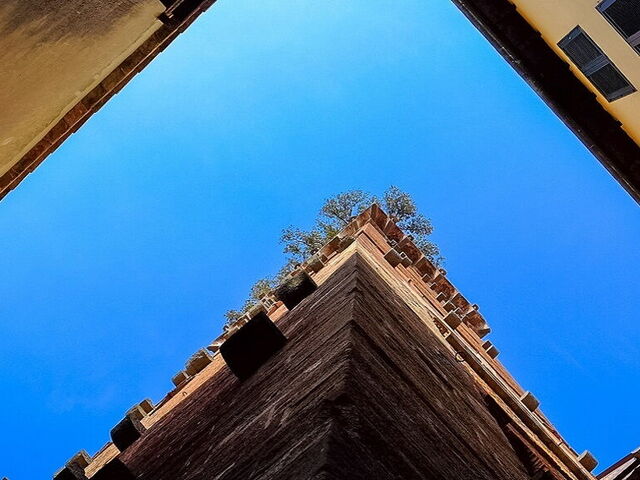
Torre Guinigi is located in Via S. Andrea 45, on the corner with Via delle Chiavi D'Oro. On top of its 45 meters there is a spectacular ambiance: a hanging garden with seven secular oaks! It seems that one of these trees was planted by Paolo
Guinigi in person and a legend tells that one of the
holm oaks predicted its death losing all the leaves when he was captured and imprisoned by Francesco Sforza. The tower was built at the beginning of the fourteenth century by the Guinigi family and it is a beautiful example of Romanesque-Gothic architecture. To admire the view from the top and visit this wonderful garden, however, you have to climb 20 flights of stairs! While the first steps are quite easy, the last ones are steep and smaller ... but don't worry: the view from the top floor will pay off for all the effort!
Instead, Torre delle Ore or "dell'Orologio" dates back to the 13th century and is located in Via Fillungo, on the corner with Via dell'Arancio. It has belonged to several important families of Lucca, but its notoriety is mostly linked to some gloomy legends. According to a popular belief, a noblewoman named Lucida Mansi would have made a pact with the
devil to stop time and stay young forever. Thirty years later, at midnight on August 14, 1623, the devil returned for
demand payment of his debt. The woman climbed running into the tower to stop the bell ringing, but she failed. The devil then took the
his soul and his body fell into the pond of the Botanical Garden, where it seems that her ghost still
appears on full moon nights. The "Tower of the Hours" is 50 meters high and its famous clock has a dial with Roman numerals and a single hand. Although it dates back to 1752, the tower already had a clock in 1390 and it was precisely because of its importance that the building was never demolished. Climbing the 207 wooden steps of this tower you will then be able to observe the magnificent mechanism of this vintage clock, as well as enjoying a breathtaking view over the whole city.
The entrance ticket for each tower costs € 5, but you can also buy a cumulative tickets to visit the Botanical Gardens, the Tower of the Hours and Torre Guinigi. In addition to these attractions, don't forget to see the other city towers, like Torre del Veglio in Piazza San Salvatore and Torre del Travaglio in Via Fillungo!
Are you ready to organize your visit to Lucca? Book one of our properties in the town's centre, like Flavia Apartaments or Villa de Ranieri!
© Alice Pilastri
Read More
Tuscany's beauties are endless! Considering its enchanted villages, dreamy landscapes and cities of art, this region is really the perfect destination for a memorable holiday.
As well as Chianti, Val d'Orcia, Versilia and Maremma regions, there is a beautiful area in northern Tuscany that most tourists do not know, but it presents many natural wonders and splendid architectures. We are talking about Lunigiana, a borderland located between Tuscany, Liguria and Emilia Romagna that has always been a land of connection between north and south. Here, a stretch of the Via Francigena passes and dozens of clashes between Byzantines and Lombards have taken place in the medieval period
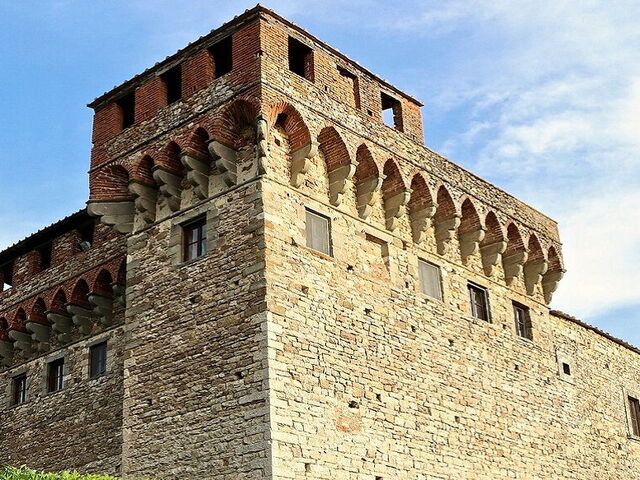
Precisely for this reason, the hills of Lunigiana feature some ancient castles built in the Middle Ages which were used to control the valleys. Many of them have been destroyed over time, but there are still some magnificent buildings that can be visited and admired.
Want to find out where the castles of Lunigiana are? Start planning your tour checking the list of the 7 most beautiful medieval castles you should visit and live an exciting experience in Tuscany!
The first town where you can find a castle is Pontremoli , also called "land of booksellers" as it houses a famous book festival. In the Middle Ages, merchants and pilgrims passing through this region were housed in Piagnaro Castle. Today, this beautiful building contains the Museum of Stele Statues of Lunigiana, which is dedicated to sandstone artifacts dating back to the pre-Roman period. The caslte dates back to the 11th century and it was part of a large defensive system built up to protect the village from enemy attacks. Although it has been recently renovated, the castle still retains a majestic appearance and it dominates the surrounding valleys from above, instilling fear in those who wish to approach.
Even Aulla was a famous stop of the Via Francigena in the Middle Ages! The road to the town passes next to two magnificent castles, namely those of Bagnone and Filattiera, as well as to Fortezza della Brunella, an imposing quadrangular building on a dark rock dating back to the Renaissance. This is a typical fortification designed for firearms and today it houses the interesting Museum of Natural History of Lunigiana.
Continuing towards "Passo del Cerreto", you will arrive in Fivizzano, a town located between the National Park of the Tuscan-Emilian Apennines and the Regional Natural Park of the Apuan Alps. It's an area of great naturalistic interest, where you can make beautiful walks or follow a trekking itineraries to explore every corner of this paradise. Not far from Fivizzano there is a charming castle called Castello della Verrucola , a perfectly preserved XII century building surrounded by high walls. A tour inside the castle is a fantastic journey through time that will take you between the legends and the terrifying ghosts that still inhabit this place!
Another castle you must visit at all costs is located in the village of Licciana Nardi : Malaspina di Monti Castle is one of the best preserved fortifications in all of Italy and it still preserves an authentic charm.
And finally, all you have to do is take a trip to Fosdinovo to admire its magnificent castle! The fort stands imposingly in the center of the village and is still in perfect condition. What makes this castle so special is the possibility to visit it at night, taking part in some suggestive night visits. In summer, small groups of visitors can go in search of ghosts with the guides of the castle, listening to the story of Bianca Maria Aloisa Malaspina. The legend tells that girl was walled alive in the castle and that her ghost still moves between its rooms and corridors...
Are you ready to organize a vacation in Lunigiana? Book Casa al Bosco, a stunning property for rent in this area!
© Alice Pilastri
Read More

October 3, 2019
The Ancient Markets of Palermo: 4 Unmissable Places to See
To discover the soul of Palermo, you must go to its world-famous markets! The oriental atmosphere of this place will make you forget you are in Italy: as most of these markets were born in the period of Arab domination, they still maintain some characteristics of the typical North African markets. The desks and the baskets of goods invade the streets, the sellers shout to passers-by to catch their attention, thousands of colors flood the streets and all kinds of perfumes fill the air of one of the most beautiful Sicilian cities. Would you really leave Palermo without having seen such a place?
Discover where to find the most beautiful and well-known markets in the city and immediately organize your trip to Palermo!
It's inside its ancient markets, called Ballarò, Capo, Vucciria and Borgo Vecchio, that Palermo reveals its authentic spirit.
Ballarò is a market located near the central station and the church of Casa Professa, where hundreds of marriages are celebrated every year. Located in the Albergheria district, this is the largest and oldest market in the whole city. In fact, it dates back to the 10th century, a period in which the Arabs had commercial relations with an Indian village called Balhara. As the spices and merchandise coming from these distant lands were sold here, its name became "Ballarò".
Its charm has remained unchanged over time and it continues to attract dozens of buyers, thanks to the cries of the local sellers and to the appealing stalls of fresh fruit and vegetables called "abbanniate". The market is open all
day long and it offers some tasty foods, such as pianelle (chickpea flour fritters), crocchè (potato croquettes) and sandwiches with spleen. Actually, this typical street food is perfect to accompany a walk around the city!
Although the market is open 365 days a year, the best time to visit it is on Sunday morning: Ballarò becomes a huge second-hand shop where you can make a lot of great deals!
Instead, Vucciria is the market that inspired a famous painting made by Guttuso. It takes its
name from the ancient meat market called "la Bucciria" and it is located between Piazza Caracciolo and the surrounding streets.
This is the most peculiar market, as the goods are displayed on special marble slabs called "balate" put on the stalls. There is a triumph of colors and scents: yellow hanging lemons,red dried tomatoes, silver sardines and the pleasant scents of spices will turn your visit into a memorable experience!
Mercato del Capo derives its name from the
neighbourhood "Caput Seracaldi", which is the Latinization of an Arabic name. It is the fish market par excellence and it extends from Porta Carini to the magnificent area of the Cathedral. The numerous stalls crowding it make it difficult to pass between them, but each of them offers all kinds of delicacies! Fruits, vegetables, fish, fine meats ... this market has everything you will need.
Finally, Borgo Vecchio market is located in a popular neighborhood standing in sharp contrast with the bourgeois districts of Politeama and Libertà. The liberty-styled buildings, the splendid port and the colors of the stalls create a unique environment where every visitor loves to get lost.
Looking for a holiday rental in Palermo? Choose a luxury property like Villa Vincenzo and enjoy your vacation in Sicily!
© Alice Pilastri
Read More
Cilento is a territory of natural and artistic treasures that can be seriously called wonderland. Since 1998, it has been included in the list of UNESCO world heritage sites to honour its unique beauty and historical importance.
This charming region is located in Campania, precisely in a rocky stretch of coast including countless bays and coves. Situated in front of a chain of high mountains, the area is bordered by the Gulf of Salerno and by that of Policastro, which offer some lovely panoramic views. Also, it is well known for the splendid Cilento National Park, set up to preserve the wild nature, woods, lakes and the rich fauna that inhabits this magic place.
However, nature isn't the only great thing to appreciate in Cilento, as there are lots of things to do and see ! Discover the unmissable sites to visit during a wonderful tour of Cilento and check out all the important archaeological sites, dream villages and architectural masterpieces to spot in this region!
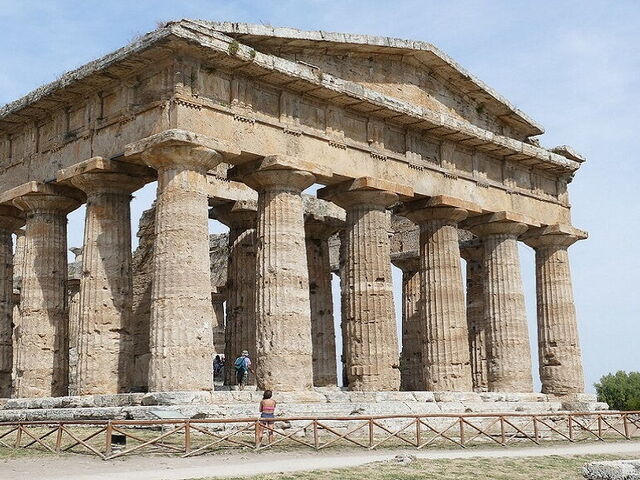
The first of the unmissable archaeological sites is Paestum, one of the most important polis of Magna Graecia. Originally called Poseidonia in honor of the god Poseidon, Paestum preserves three splendid temples of the Doric order in excellent condition, which are dedicated to the gods Neptune, Athena and Hera. Don't miss the National Archaeological Museum, which houses countless splendid artifacts!
Instead, the archaeological site of Velia contains the remains of a city-state founded in the 6th century BC. It still retains a beautiful look, as the harbor, the Hellenistic Baths, the Acropolis, the Agora, the Southern and the Archaic District are almost intact. It was an intellectual and cultural center of great fame, since the Eleatici Philosophical School was born here.
Finally, you must see the charming "Certosa di San Lorenzo di Padula", which is the largest in Italy and the one with the largest cloister of the world (15,000 square meters)! Today, this Charterhouse houses the Provincial Archaeological Museum of Western Lucania, which contains the archaeological finds coming from the necropolis of Sala Consilina and Padula.
After leaving the archaeological sites, don't forget to visit the most picturesque villages of Cilento!
Agropoli contains a magnificent Aragonese castle and some beautiful beaches, such as Baia di Trentova, Punta Licosa is built around a thirteenth-century castle, while Castellabate is known for being the set of the successful Italian film "Benvenuti al Sud"! The tour then continues in the fishermen village of Acciaroli, which inspired Hemingway to write some of his books, passes through Palinuro and its splendid Blue Grotto, and it ends in Camerota, where you can find a rich Byzantine art heritage. Do you love mysterious and legendary places? Then you can't miss a visit to Roscigno, a totally abandoned town where time has stopped two hundred years ago!
The tour is over...but do you really want to leave Campania without tasting a delicious buffalo mozzarella? The streets of Cilento are dotted with dairies, especially in Paestum and in the Sele valley. These authentic mozzarellas have an excellent quality, thanks to the long tradition of buffalo breeding that characterizes these areas. Don't forget to make a stop!
Now, are you ready to book your holiday in Cilento? Book one of our magnificent properties for rent in Campania, like the beautiful Villa Rupe Alta and start planning your memorable trip!
© Alice Pilastri
Read More