Our Blog: Travel Tips
Planning a trip to Italy? Browse and read our useful and informative articles about the endless range of attractions and experiences in this lovely country.
Travel through the beauties of Italy with us. Visit our blog!
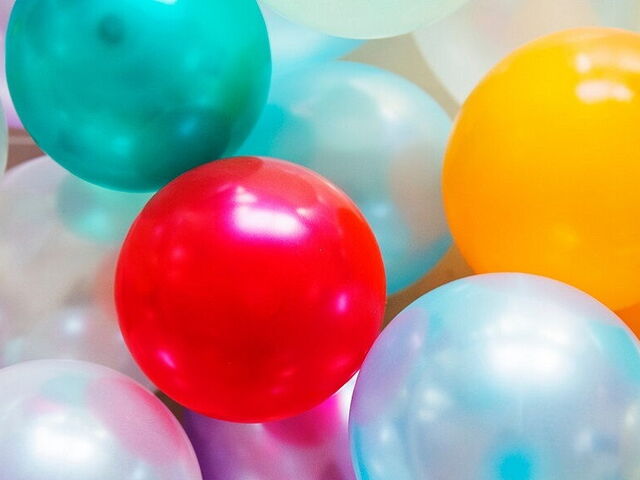
February is the month of Carnival. It’s about colors, joy, music, celebrations and multi-colored costumes that crowd the streets of cities and villages. It’s the moment when “ogni scherzo vale”(every joke counts) and children let their fantasy fly masquerading as pirates, princesses, superheroes, witches and fairies. The most important Carnival celebration in Tuscany is organized in Viareggio (LU), a maritime city located in the Versilia area. Every weekend of February, thousands of people gather in its streets to take part to one of Europe’s best street parades, which is composed by dozens of wonderful floats built by local artists.
The first show took place in Via Regia in 1873, when some young men who lived in Viareggio decided to celebrate Fat Tuesday with parade of decorated coaches. This tradition continued for some years, until coaches were replaced by triumphal floats prepared in Darsena boatyard and started to march along the seafront promenade. Though it was suspended during the first world war, it pursued after 1921, when the official hymn “Coppa di Champagne” was composed, the “Viareggio in Maschera” magazine was founded and a marching band was placed side by side to the parade. Artists started to use a new material called “cartapesta” in 1925: it was made with newspapers, water, flour and glue and it was much cheaper, lighter and easier to use. The mask of Burlamacco, the symbol of Viareggio, was ideated in 1930 and it represented the two main features of the city, which are the summer and the “carnevale”. After the second world war, the celebration experienced a sudden boom: it started to be broadcasted live by RAI every year, a special area called “Cittadella del Carnevale” was created to build and to conserve the floats and an increasing quantity of papier-mache giants took part to the parade.
Nowadays, allegoric floats of sport, politics and cinema celebrities compose a magnificent procession of satirical masterpieces. As well as the five masked parades (on February 5th, 12th, 18th, 25th and 26th February), the city organizes children activities, workshops, pyrotechnic shows, music exhibitions and guided tours of the “Museo del Carnevale di Viareggio”. The tickets that allow to participate to a single celebration cost between 15 and 18€, but those who wish to participate to more than one show can buy cumulative tickets.
Don’t miss this opportunity! Book one of our properties in Versilia and check our Villa Camaiore !
Read More
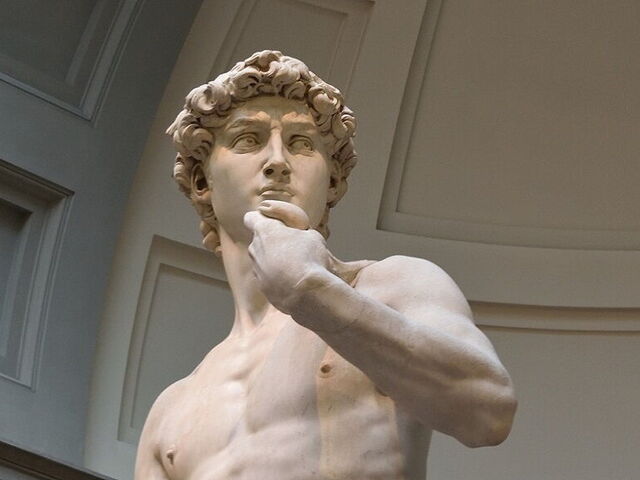
If you’re in Florence you cannot forget to visit the Galleria dell’Accademia before you leave it, as it’s one of its most important museums. The second most visited museum in Italy after the Uffizi conserves seven Michelangelo masterpieces, one of which is the unique David.
Its story began in 1784, when Granduke Pietro Leopoldo di Lorenza decided to reunite the “Accademia delle Belle Arti” with the “Accademia delle Arti del Disegno”, other institutions and a gallery where students would study, observe and copy the artworks inside it. Important masterpieces were placed in it, like the “The Rape of the Sabine Women” by Giambologna, the “Adoration of the Magi” by Gentile da Fabriano and the “The Madonna and Child with St. Anne” by Masolino and Masaccio. The Gallery was expanded between 1865 and 1971, when Florence became the capital of the Italian Reign, and it changed its name in “Galleria Antica e Moderna” becoming the first museum of contemporary arts in the new State. In 1872, the David sculpture was transferred in the museum from Piazza della Signoria as this place was too dangerous for a masterpiece like this. After the moving of numerous works of contemporary art like those of Botticelli or Beato Angelico, the museum had to change its name into “Galleria dell’Accademia” and it still conserves it nowadays. It is formed by several splendid halls which are the Hall of the Colossus, the Hall of the Prisoners, the Tribune, the “Gipsoteca Bartolini”, the Florentine Gothic room, the museum of musical instruments and the collection of Florentine works made between 1370 and 1430.
Book one of our properties in Florence and visit this wonderful museum! See our suggestions in Florence!
Tickets: full price, half price(for UE citizens between 18 and 25 years old and Italian school teachers) or free (for under-18s, disabled persons, ICOM members and journalists; the first Sunday of each month is free for everybody). I suggest you to buy your ticket in advance on internet or through the call center service paying an additional charge for the booking instead of spending 2 or 3 hours in the queue!
Opening hours: from 8:15am to 6:30 pm, from Tuesday to Sunday
Address: Via Ricasoli, 58-60, 50122 Florence
MICHELANGELO’S DAVID (1504)
The initial project intended to create some sculptures for the buttresses of the Dome of Florence and it was commissioned to Agostino di Duccio in 1463-4, who worked on an enormous block of marble. However, he didn’t finish it and the statue was left in the depository of the Museo dell’Opera del Duomo until 1500, when Michelangelo completed it. An art commission then gathered to decide its location: Botticelli suggested to put it next to the Dome, others in the courtyard of Palazzo Vecchio, Leonardo da Vinci proposed to hide it in the Loggia dei Lanzi, while Filippo Lippi and Pier Soderini preferred to put it in front of Palazzo Vecchio. In fact, here it would have acquired a symbolic meaning, as it referred to the civic virtues of the city of Florence. This was its final position, but it soon became the target of some stones thrown by pro-Medici citizens and it also broke its arm during a riot in 1527. The David is in the Tribune of the Galleria dell’Accademia since 1872, while a marble copy has been put in front of Palazzo Vecchio. The sculpture is 434 cm high and its position is similar to the classical “heroic nude” ancient statues. The proportional errors in the head and in the hands disappear when it is observed from a lowered point of view, as its original position had to be high on the buttresses. The work portrays David before he throws the rock against his enemy Goliath, he has wrinkled eyes which focus on his enemy and his pupils have been drilled to confer more intensity. Symbolically he represents the peak of divine creation, he’s physically perfect and he’s also the allegory of the victory of democracy over Medici’s tyranny in Florence.
Read More
Very few people know about the importance that the castle of Montegufoni has had in the rescue operation of hundreds of Medieval and Renaissance masterpieces during the Second World War. Actually, the third episode of National Geographic’s “Nazi World War” program describes and examines this fact in depth and I suggest you to check the TV schedule of your country to watch it!
In 1942 war had already started since two years and Italy was facing the most problematic and arduous period. Allied air raids over the main cities became a real and serious threat so authorities began to consider the necessity of saving the works of art stored in the most important museums, especially those in Florence. They decided to move the most valuable masterpieces to the castles and villas found in the countryside, in order to put them in safe places, away from military or bombing targets. This choice was tough and ambitious, there was no certainty about the achievement of the operation and this worried the directors of the museums and the other authorities.
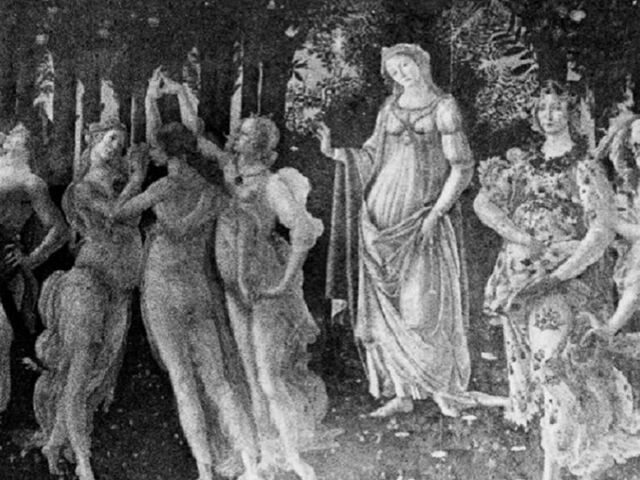
As the Castle of Montegufoni had an isolated position 20 kilometers away from Florence, it was chosen as one of the main destinations. In November 1942, more than 260 masterpieces were moved in the building from the Uffizi, the Accademia, the Bargello, the Palatine Gallery, the San Marco and the Santa Maria Novella museums. Some of these works were the ”Annunciazione” by Filippo Lippi, the ’”Adorazione dei Magi” by Ghirlandaio, the “Maestà di Ognissanti” by Giotto and the “Primavera” by Botticelli.They were stowed in the castle’s rooms and some old black-and-white photographs portray them leaned against the walls, next to the ordinary furniture.
Everything was fine until summer 1944, when the front passed from Montegufoni: the German army in withdrawal was rising the peninsula destroying everything it found, damaging properties, goods and committing crimes against the Italian population. A unit of German paratroopers occupied the castle in order to use it as a defensive fortress. The Commander needed space and he ordered to clear the corridors from all the works of art they had been filled with, demanding to the farmer (who had assumed the responsibility to safekeep the works) to set them on fire in the castle’s inner court. It could turn into a tragedy causing the loss of a humanity heritage, but the farmer didn’t lose his courage: he used the famous Chianti wine to get the German soldiers drunk, so that they forgot to destroy the masterpieces and left the castle some days later.
When the Allied arrived, they realized how important the paintings were and a group of “Monuments Men” came along: these soldiers were designated to protect and safeguard the works of art from Nazi wrath and they’ve been represented in a recent film starring George Clooney. The important discovery even encouraged General Alexander, an important senior British Army officer, to visit the castle.
A few months later all the works were repositioned in the museums they came from and where millions of visitors see them every year. Unfortunately, few of them are aware of the significance of the Castle of Montegufoni, which has allowed to save such a beauty from the past destruction.
Read More
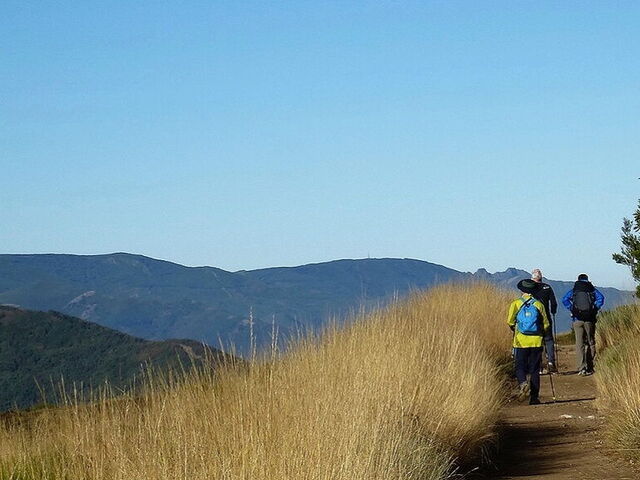
There are some pilgrimage routes that all Christians are lead to travel at least once in their life for devotion, penitence or simply to have an unforgettable experience. The “Via Francigena” is the path connecting Canterbury in England to the tomb of apostle Peter in Rome and it was recently recognized as one of the “peregrinations maiores” alongside Santiago de Compostela and Palestine.
The first historical sources about it date back to 10th century, when bishop Sigeric described its journey from Rome, where he got to be received by the Pope, to the cathedral of Canterbury from where he came. The name “francigena” means “coming from the Frankish land” as it passes through the territory of France for a long stretch. Since 1994, the path has been declared a “Cultural Routes of the Council of Europe” and this international fame leads thousands of pilgrims to travel it every year.
The 1600 km route is divided in 86 stages of 22-23 km that allow to stay in low cost “pilgrim” accommodations. However, you can split the path as you want to stop in one of our villas in Italy along the route!
The pathway starts in Canterbury and Dover to cross the English Channel and reach Calais, in France. It continues through Reims, Besançon, Losanne in Switzerland and the Alps, in correspondence to the Great St Bernard. The Italian itinerary starts in Aosta Valley and it continues in Piedmont, passing from Ivrea or the Susa Valley to reach Vercelli. It passes through Pavia, Piacenza, Parma, Segalara, Fornovo di Taro, Berceto and Pontremoli. You’ll then get to Tuscany and you’ll see Camaiore (where you can stay at Villa Raffaela) Lucca (with Villa Flavia), Porcari, Altopascio (where we suggest you Villa Marginone), Fucecchio, San Miniato (with Il Fienile di Giovanna), Castelfiorentino, San Gimignano, Poggibonsi, Colle di Val d'Elsa, Siena (with Villa Righi), Montefiascone (with I Gigli di Bolsena ), Viterbo and you’ll finally reach Rome.
It’s recommended to travel the “Via Francigena” in May, June, September or October when the weather isn’t too hot or cold and the Great St Bernard Pass is open. It seems an impossible and threatening challenge, but the road doesn’t present any technical difficulty: with an adequate equipment, a lot of water and the right sun and rain protections, everyone is able to get to the end of their trip. And believe me, it’s really worth it: it’s a wonderful voyage through European beauties that isn’t easy to forget.
Read More
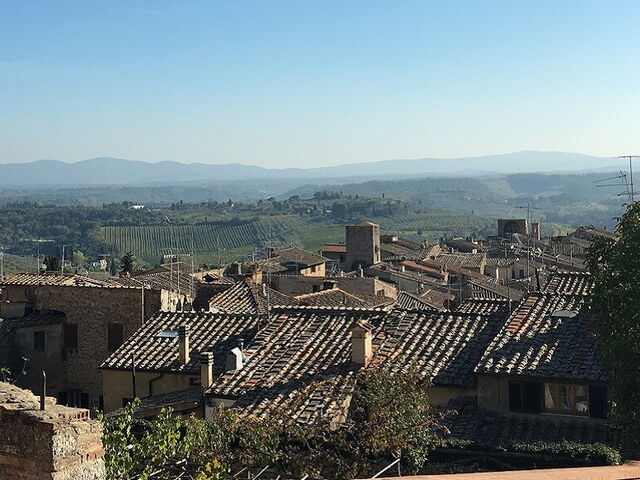
Certaldo is a wonderful village of the Valdelsa region, not far from Siena and Volterra, right on the top of a hill and protected by solid walls. About 16,000 people inhabit this unique center which became famous worldwide as it was the motherland of a well-known Italian writer, Giovanni Boccaccio.
Its Etruscan and Roman origins were discovered in occasion of the finding of ancient archaeological artifacts such as potteries, urns and graves. The Medieval period was anyway the most flourishing for this city, as it saw the construction of many buildings like the Palazzo del Vicario (10th/11th century), the St. Tommaso and Prospero Church (11th/13th century) or the surrounding walls with their access doors. It also became an important step of the “Via Francigena” itinerary, which was the road connecting Northern Europe to Rome that was transited by thousands of pilgrims.
The flag of Certaldo is very strange: it’s white, red and it portrays an onion on the left. One of its symbols and typical products is in fact the “cipolla di Certaldo”, a quite big red onion with a sweet flavor that is even mentioned in Boccaccio’s “Frate Cipolla” novel. Tasting this regional specialty is something you must do in Certaldo, but don’t forget to try the “mercacci” as well, which are special biscuits made with chocolate, almonds and dried fruits invented in honor of the local poet.
The most picturesque spot of this city id undoubtedly Certaldo Alto: the historical city center dominates the valley from the top of the hill and it’s possible to reach it using a funicular railway or an uphill pathway. It has kept its medieval aspect so it really seems that time has stopped since Middle Ages: just like Giovanni Boccaccio seven centuries ago, you’ll walk along the narrow alleys next to the stone “house-towers” and surrounded by earthenware tiles.
The house of Boccaccio is today a museum you will be able to visit during your stay in Certaldo and it’s something you cannot miss. It’s located in the main street, via Boccaccio, and it’s a small building with century-old interior furniture containing the handwritten masterpieces by the poet and their first translations.
Don’t forget to visit Palazzo Pretorio, a symbolic monument of the city which hosted Counts Alberti family in the 13th century. Admire its peculiar, beautiful façade and walk through its corridors, its prisons, its archive, its hearing room, its chapel and its wonderful private rooms.
Another important place is the Museo dell’Arte Sacra: it was inaugurated in 2001 and it presents many beautiful medieval works which were found in the churches near Certaldo.
Although this center is an authentic urbanistic jewel that is beautiful in every moment of the year, it is particularly suggestive in July, when “Mercantia” festival is organized. This international street art festival lasts five days and it sees the participation of dancers, musicians, acrobats, fire-eaters and other street artists who crowd the streets recreating a magic and unique atmosphere.
What are you waiting for? Book one of our villas in Certaldo and visit this wonderful borgo! We suggest you Villa Orchidea, or Certaldo Apartments!
Read More
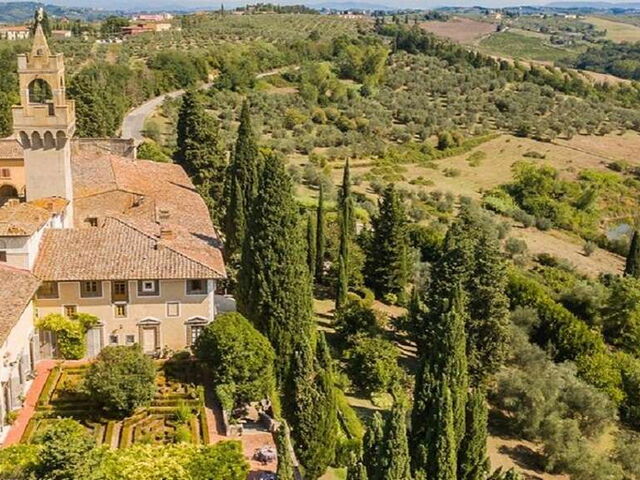
Some weeks ago, a National Geographic troupe arrived at the Montegufoni Castle to investigate on the story behind the important Renaissance masterpieces that where hidden here during the Second World War. A whole episode, the third of the "Nazi World War Weird" show, was dedicated to our wonderful castle and it will be soon broadcasted in worldwide National Geographic Channels.
"As the chaos of World War II engulfs Italy, a British officer makes a shocking find; a 900 year old castle near the front line still holds a collection of priceless works by some of Italy's greatest Renaissance masters. But who put the masterpieces there and how did they survive the battle raging less than 2500 yards away?"
Don't miss it! Check your country's TV schedule:
WATCH IT ON...
National Geographic Italia: "Misteri Nazisti: La fortezza italiana"
Thursday 22nd December at 15:25
National Geographic UK: "Nazi Weird War Two: Secret Art Fortress"
Tuesday 17th January at 20:00
National Geographic South Africa: "World War Weird: Secret Art Fortress"
Tuesday 17th January at 22:50
National Geographic France: "Mystères Nazis: La forteresse aux œuvres d'art"
after Thursday 5th January
Read More

A famous and ancient tradition in Italy is undoubtedly the preparation of the crèche during Advent time. It’s a representation of Nativity assembled in houses, churches or along city streets with statuettes of various dimensions or, sometimes, with real people who decide to take part to a living crèche. It’s thanks to this kind of centennial customs that the past keeps accompanying current and future generations, because otherwise it would be forgotten and it would soon disappear. Some crèches are real art masterpieces, so don’t forget to visit the best ones in Tuscany which have been built after months of hard work by artists and carpenters!
We suggest you eight places you need to see during your holiday in Tuscany and we also add our advice about the properties you should book for your stay:
CASTELFIORENTINO:The inhabitants and the artists of this city between Siena and Florence fill up the old town center, its streets, windowsills and balconies with dozens of their handmade creations. Often, they use uncommon materials such as sugar, pasta, plastic or cathode ray tubes of old televisions. The biggest and most beautiful crèche is prepared in the Oratorio San Filippo and it covers a surface of about 50 square meters.
LECORE (SIGNA):
A few kilometers from Florence you find Lecore (Signa) where a big crèche is prepared every year in San Pietro church: it covers the altar and the apsis, it changes every year and its small houses are made of cardboard.
Where to stay? Choose Villa la Selva !
CIGOLI:
Cigoli, a village near San Miniato (PI), hosts one of Tuscany’s biggest technological crèches in its Santuario della Madre dei Bimbi. It covers a 100 square meters surface and, thanks to modern technologies, the cycle of day is recreated through some lights effects. Its dimensions and aspect change every year and its beauty is indisputable.
Where to stay? Choose Il Fienile di Giovanna!
PESCAGLIA:
Right in the middle of a wood in the "Media Valle del Serchio", in the province of Lucca, you will find a grotto called “Buca delle Campore” where a peculiar crèche is prepared every year. Its beauty is especially linked to its scenario, with a magical light and calcareous stalactites. The cavern can be reached through a 600 m walk through the trees and it’s indicated for adventurous tourists. But don’t worry: it’s really worth it.
STAZZEMA:
“Antro del Corchia” crèches in Stazzema (LU) are the most suggestive in the region: they are assembled in a well-known, huge cave (2km long) by the “Maestri del Carnevale di Viareggio” and by the students of the Liceo Artistico “Stagio Stagi” in Pietrasanta. They really deserve to be seen because of the unique beauty of the place they’re in and of the masterpieces they're formed by.
Where to stay? Choose Villa Oliveta !
LA CAVALCATA DEI MAGI (FI):
The “Cavalcata dei Re Magi” is a celebration organized every year on January 6th in the center of Florence since the time of Cosimo de’ Medici and it was well beloved by his family. Actually, this celebration was cancelled after the family's fall and it wasn’t restored before 1996. The participants wearing ancient Renaissance costumes are more than 700, along with the representatives of foreign religions' communities. The procession starts in Piazza Pitti and it ends in front of Santa Maria del Fiore cathedral, where the Magi give their presents to the crèche near the Dome.
!
SAN ROMANO:
In the “Santuario della Maria Madre della Divina Grazia” in San Romano (PI) there are two wonderful crèches: one is in the cloister square covering 300 square meters, while the second is in the Medici Saloon and it has a Neapolitan style.
Where to stay? Choose Villa Lorenza !
CERTOSA DEL GALLUZZO (FI):
Every year, Cistercian monks assemble in the small chapel in the Certosa del Galluzzo (FI) a beautiful crèche where they recreate day and night with light effects. It is mechanized and it’s perfect for children, who always get surprised looking at it.
!
Read More
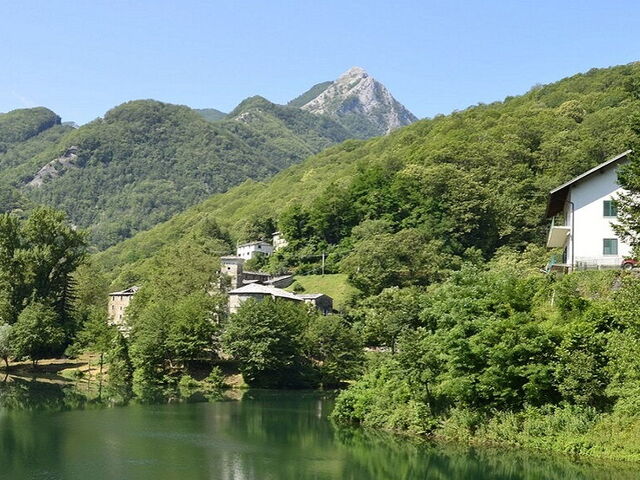
Barga is a locality in Garfagnana which has been rewarded as “città slow”, “bandiera arancione” and one of Italy’s best “borghi”. It’s one of the most important and biggest villages in the province of Lucca and it stands out on the top of its mountains, surrounded by green woods, fields and beautiful natural lakes. As well as being a noteworthy historical, cultural and artistic center, Barga grants you a relaxing stay during which you’ll be able to take part to some organized activities in its nature, such as trekking or horse riding excursions.
WHAT DO YOU NEED TO SEE IN BARGA?
You probably didn’t know that a well-known Italian poet called Giovanni Pascoli lived here: that’s why you can’t skip the visit to “Casa Pascoli” in Castelvecchio Garfagnana, a village in the surroundings, where he stayed for about seventeen years and where he decidied to be buried. The house is now a museum that can be visited, as it conserves some Pascoli’s works and its original home furnishings. Moreover, its garden is the location of special events, shows and exhibitions, like the “Festival dei bambini” in August (Museum opening hours: from October 1st to March 31st: Tuesday 2 pm-5:15 pm, from Wednesday to Sunday 9:30 am-1 pm and 2:30 pm-5:15 pm; from April 1st to September 30th: Tuesday 3:30pm-6:45pm and from Wednesday to Sunday 10:30am-1pm and 3pm-6:45pm).
Another place linked to this poet is the “Teatro dei Differenti”, where he pronounced his speech in 1911 in favor of the war in Libya. Th theater was built in 1795 over a pre-existing 1689 structure and it still preserves the original architectural elements.
In Barga, you also need to see the magnificent Dome or “Collegiata di San Cristoforo”, built between the XI and the XVI century in Romanic style. Inside there are some ancient frescos, sculptures, stoups and a wooden statue dedicated to the city patron.
Furthermore, don’t forget to discover Palazzo Balduini, Palazzo Angeli, Palazzo Pancrazi, Caffè Capretz, Loggia Mercanti, Palazzo Podestà, Chiesa del Santissimo Crocifisso, Chiesa della Santissima Annunziata and the “Museo Civico del territorio di Barga” in Palazzo Pretorio (Museum opening hours: from June 1st to September 30th 10am-12:30pm, 2:30pm-5pm. Booking is needed)!
LOCAL FOOD AND EVENTS
During your holiday, also remember to taste some local delights, like lake trouts, mushrooms, chestnuts and vegetable soups: all the ingredients are found in this area and they’re totally natural.
What are you waiting for? A vacation in Garfagnana is a must-do in Tuscany, so check our villas in Castelnuovo di Garfagnana (LU) and choose your favorite between Villa il Nido and Villa Saida!
Read More
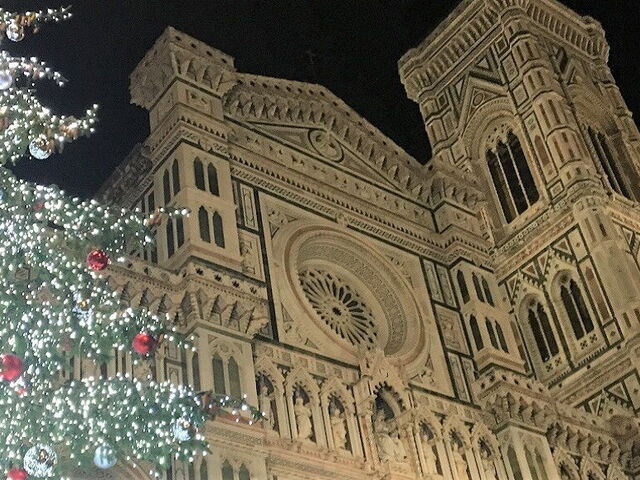
December has begun and you can already smell the scent of Christmas in the air! It’s time for people to take out their scarves, their wool hats, their colored decorations and their small firs to trim them in the sitting room with their family. Even the main Tuscan cities prepare themselves to Advent period with some wonderful initiatives you cannot miss during your holiday Tuscany: one of these is the “Weihnachtsmarkt”, the German Christmas market in Piazza S.Croce in Florence.
From November 30th to December 21st, the square in front of one of Florence’s best churches fills up with dozens of small wooden houses, among which you’ll be able to buy objects to garnish your crèche, Christmas tree or your house. However, it’s the culinary itinerary between international flavors that will really be worth the visit and that will astonish you for the variety and the quantity of different foods! They come from all parts of Europe and they’re outstandingly reunited in just one place: taste Italian, German, Hungarian, Polish and French specialties like the famous brezels and wurstels!
The atmosphere is made even more magical by its amazing scenery, the ancient buildings and the peculiar beauty of Florence’s old town center surrounding it: now, you just have to visit yourself renting a property in the city to discover it!
Moreover every Sunday “Bianca Natale”, Santa Claus’ daughter, will get to the market to meet the children while Saturday 10th and Sunday 11th the lyrical choir “Light Gospel Choir” and the “Bandierai degli Uffizi” company will perform in the square and will offer incredible shows to its visitors.
Read More
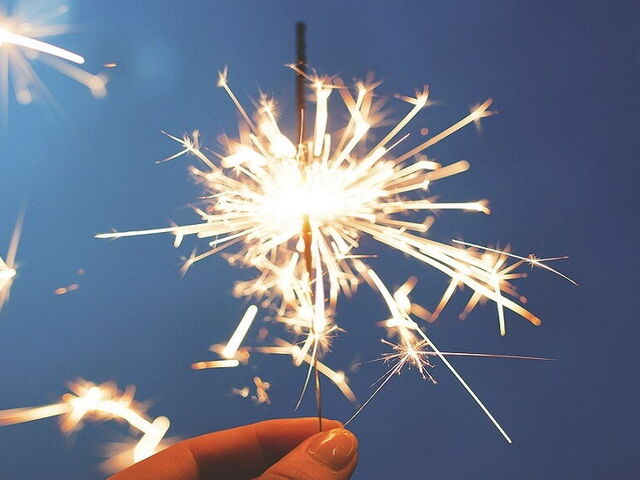
New Year’s Eve is a magic moment that deserves to be lived in the best way. In Italy, there is almost an embarrassment of riches: some people decide to spend it on snowy mountains, some go to the seaside, some celebrate it in private houses with their relatives and some visit the centers of Italy’s best cities. Innumerable places organize parties, open-air concerts and pyrotechnical shows that fascinate thousands of people who come from all over Europe to make their night unforgettable.
Here's a list of the cities we suggest you to visit on the next 31st December’s night:
1. ROME
Take advantage of this opportunity to visit this amazing city and to admire its spectacular monuments, like the Pantheon or the Colosseum. Each year, thousands of tourists crowd into the illuminated streets and participate to the “concertone” in Circo Massimo and Fori Imperiali, where many Italian singers perform. Even many clubs like "Spazio 900" propose special parties to celebrate the new year.
Are you interested in renting a property for your holiday?
Choose one of our villas in Rome!
2. ALGHERO
Even Sardinia gives the possibility to spend a New Year’s Eve in the name of fun, good music and breathtaking seaside panoramas. As well as photographic expositions and theater festivals, the touristic harbour presents Pago &Stefano Nosei cabaret, fireworks and a hilarious concert by Elio e le Storie Tese.
Are you interested in renting a property for your holiday?
Choose one of our villas in Sardinia!
3. NAPLES
The celebration will have its heart in Piazza Plebiscito, where you cannot miss the amazing concert with Enzo Avitabile & Bottari, Max Gazzè, Nello Daniele and many other artists. Fireworks will start to light Castelo dell’Ovo at 1:30am and you’re then invited to participate to Lungomare Caracciolo entertainment, where djs and various kinds of music will animate your night.
Are you interested in renting a property for your holiday?
Choose one of our villas near Naples!
4. VENICE
Venice is the perfect destination for those who dream about a romantic night and fairy tale atmospheres. Some of the many events in this city are the classic “mass kiss” in Piazza San Marco and the traditional concert in Teatro la Fenice.
Are you interested in renting a property for your holiday?
Choose one of our villas in Venice!
5. FLORENCE
Florence's atmosphere becomes even more magic and spectacular than usual, thanks to its decorations and to the light that reflects into Arno’s waters. As well as being the right occasion to visit the city and its museums, life the Uffizi or the Accademia, you will be able to enjoy the concerts in Piazza della Signoria and Piazza Pitti, where singers like Alessandro Mannarino and Irene Grandi will perform.
Are you interested in renting a property for your holiday?
Choose one of our villas in Florence!
6. ORVIETO
This city is perfect for those who want to spend a New Year’s Eve in the name of music! From December 28th to January 1st, Orvieto transforms into the “Winter Jazz Capital” and it hosts international guests in historical palaces, theaters and restaurants, while street bands perform in its streets. You can take part to one of the numerous initiatives which are organized in these days and you can take advantage of its special atmosphere and beauty more than ever.
Are you interested in renting a property for your holiday?
Choose one of our villas in Orvieto!
7. VERSILIA
Versilia transforms into a single welcoming locality that guarantees absolute fun to all-aged people, especially to younger ones, who are welcome in some of Italy’s most important disco clubs to shout the countdown. The sea will be coloured by firework's bright colors at midnight and the atmosphere will therefore get even more charming.
Are you interested in renting a property for your holiday?
Choose one of our villas in Versilia!
8. CATANIA
The Sicilian city will be animated by a lot of good music on its longest night! Piazza Duomo will host a special concert, while on January 1st you’re invited to take part to the traditional concert in Teatro Lirico Vincenzo Bellini. It’s an unmissable opportunity to admire the typical landscapes, the colorful sea and to taste the traditional flavors of this Mediterranean island!
Are you interested in renting a property for your holiday?
Choose one of our villas in Catania!
9. OTRANTO
If you’re looking for a different place where to spend your New Year’s Eve, then choose Otranto, in Apulia, where you’ll get the opportunity to watch the first dawn of the year. Punta Palascia lighthouse is actually Italy’s eastern spot and it separates the Ionian sea to the Adriatic one. As well as admiring the natural beauty of this place, you'll be able to reach Otranto’s center and to take part to its “Alba dei Popoli” festival, a party until dawn.
Are you interested in renting a property for your holiday?
Choose one of our villas in Apulia!
Read More