Our Blog: Travel Tips
Planning a trip to Italy? Browse and read our useful and informative articles about the endless range of attractions and experiences in this lovely country.
Travel through the beauties of Italy with us. Visit our blog!
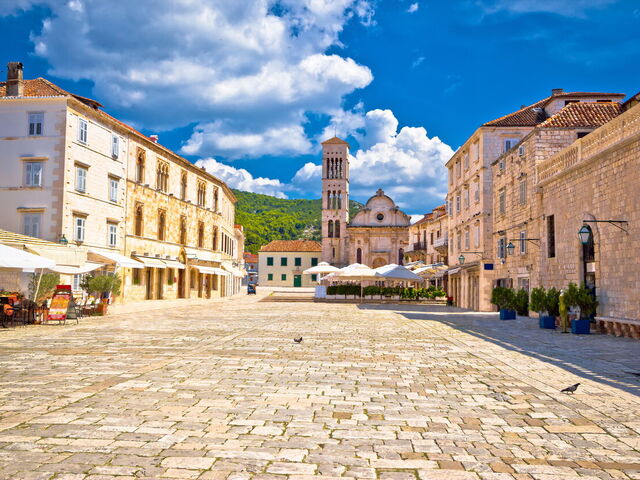
The Island of Hvar, with its 270 km of coastline, is the longest island of Dalmatia and is located among the islands of Vis, Brac and Korcula. Its paradise beaches, unspoiled nature and millenial history played in favor of Hvar, turning it into one of the most visited and loved places in Croatia by tourists from all over the world.
If you are going to stay in Hvar and you don't know what to do, read our top 10 list of unforgettable activities and unmissable places to visit on the island of Hvar!
1. ST. STEPHEN'S CATHEDRAL
Located in the historical centre of Hvar City, St. Stephen's Cathedral is one of the main attractions for tourists. The original building was built in the XII century, but it has been demolished and rebuilt many times, until 1755 as we can see it now. The Cathedral is dedicated to St. Stephen Pope and martyr and houses three poorly decorated naves. The real beauty of this Cathedral is its frontal square: ruled by the color white, it has many bars and restaurants on its stone pavement..
Wherever you are, every road will lead you to this beautiful square!
2. THE FORTRESS
The main panoramic point is Fort Fortica, also called Spanjola. It has a huge historical value for the city, in facts it was built in the XVI century on a 100 m high tall hill under the Venetian rule and then it was used as a shelter in 1571 by the island's inhabitants when they were invaded by the Turkies. Inside the Fortress, you can find an interesting museum, but the real beauty of this place stays in its breathtaking panoramic view extending on the city of Hvar to the nearby Pakleni Islands.
3. FRANCISCAN MONASTERY
The Franciscan Monastery is a place of peace, silence and serenity. It was built during the XV century as a shelter for sailors and then turned into a Monastery. Inside, there is a rich museum which collects coins, amphoraes and books, besides several paintings, among which the most important is "The last dinner".
4. THE THEATRE AND THE ARSENAL
The theatre of Hvar has got a huge historical value: it was opened in 1612 and is one of the oldest theatres in Europe. The Teatre was built on top of the Arsenal, one of the most beautiful buildings in Hvar City., which was used as a storage of boats and other nautical materials. The Theatre hosts the Contemporary Art Gallery and is still active, especially in the tourist season.
5. BEACHES
Don't foget to visit the magnificent island's beaches! There are several beaches because, as mentioned, the coastline extends for 270 kilometres! Three marvellous beaches selected for you nearby Hvar City are Dubovica, Zarace and Milna, three charming bays where you can relax, sunbath and enjoy wonderful sunsets.
6. PAKLENI ISLANDS
Pakleni Islands are a small archipelago consisting of little islands and sea rocks. The meaning of their name is controversial: it literally means "Hellish Islands", but pakelna also means pine. In facts, these islands houses meny pines, used mainly for the construction of boats and buildings. Over a long period of time, the term paklina has been linked to the term pakao (hell) and that's how a linguistic mistake changed the whole meaning of the Islands' name. The main island is Saint Clement, that has a small village built by Egen Meneghello, a pharmacists, in 1848. In the village there is a Greco-Roman amphoraes' museum, which represents the biggest collection of amphoraes in the whole country!
Other beautiful Islands of the Pakleni Archipelago which are worth a visit are Jerolim, Marinkovac and Šćedro, where you can enjoy crystal clear water, cuisine traditions and many activities as water sports.
7. STARI GRAD (OLD TOWN)
Stari Grad is a very ancient town (its name literally means ""Old Town"") founded in 384 b.C.. It's located on the North-West side of the Island in a gulf safe from attacks, so Stari Grad was known as a strategic spot where Adriatic Sea's sailors could stop during their long trips. This town hosts every year music and sport events and is a real jewel of the Island. With its vineyards and its fertile fields it offers to its visitors excellent typical products, among which a delicious wine. Stari Grad is for sure an unmissable place during your stay in Hvar!
8. BRUSJE
If you want to see the authentic side of Hvar, Brusje is made for you. Among gardens, paths and stone walls, the silece reings. This beautiful village has been abandoned since the end of II WW, but the true Island life took place here. Populated since the 15th century by farmers and shepherds, Brusje now has only 150 inhabitants, who are involved in tourism and the production of essential oils, especially of lavender derivatives. The town is famous for its characteristic roofs dating back to the Roman era and for the Mediterranean atmosphere that you can breathe: visiting Brusje is like diving into the authenticity of the past of the Island of Hvar. Here you can visit the Church of St. George, the fish market and the retirement home of Macirovo
9. JELSA
Located in the central area of the island, the town of Jelsa is a gem not to be missed. It has indented coasts and offers its visitors an incredible panorama. It is surrounded by mountains and nature, so much so that it is home to one of the most beautiful parks in Dalmatia, Perivoj. The city has always been inhabited and visited by tourists, presenting monuments and buildings of historical, artistic and cultural interest, as well as its characteristics villae rusticae , houses built across the fields and used for rest and relaxation. Later, the same houses were used by ethnologists and herbalists as a support to carry out their research.
10. VRBOSKA
The beautiful town of Vrboska is the smallest on the whole island of Hvar. It is known as little Venice for its canals and bridges. Its architecture is made up of buildings in Gothic, Renaissance and Baroque styles and the attractions that are worth a visit are the fishermen's museum (which houses a collection of nets, fishing tools and fish processing machinery), the church and fortress of Saint Mary Grace.
What are you waiting for? Book now you stay in Hvar!
Browse our selection of villas in Hvar, like Villa Liza, Villa Mare and Villa Cvita.
Read More
July 26, 2021
Alcantara Gorges: Everything You Need to Know!
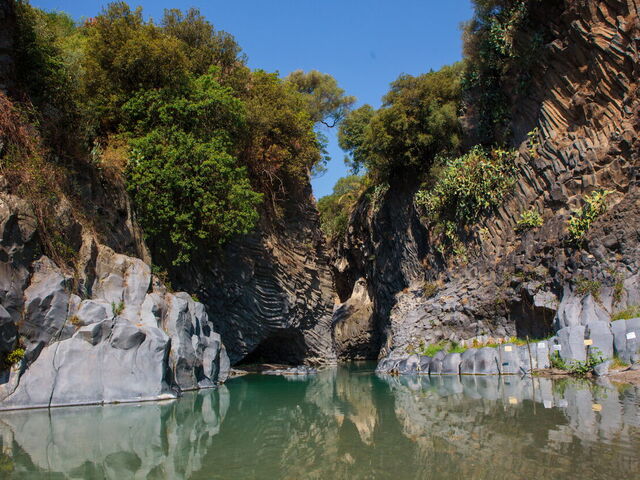
The Alcantara Gorges, also called Larderia Gorges, represent one of the most suggestive and less known place in Eastern Sicily. This paradise is located between the provinces of Messina and Catania, more precisely between the municipalities of Castiglione della Sicilia and Motta Camastra. The canyon was formed by the lava stone erosion, which took place over thousands of years by the Alcantara river, one of the most important rivers in Sicily. The most impressive and famous gorge of Alcantara is located in Fondaco Motta and is more than 6 km long, but only the first 3km can be reachable.
The lava stone walls, eroded by Alcantara, date back to more than 8000 years ago! In fact they are the result of lava flows open at that time and in more recent times as a result of volcanic eruptions, which have created overlapping different prismatic forms of the lava stone itself.
The territory of the Alcantara Gorges obtained in 2010 the European recognition of European Destination of Excellence
(EDEN).
The access routes to the gorges are different and varied: you can choose between a visit to the small gorges, the path of the Gole di Larderia and the of Montagna Grande, the path of Castiglione di Sicilia, the path of the Castello di Calatabiano or the one that runs along the banks of Alcantara. The difficulty levels are different, to give the possibility to beginners and advanced to enjoy this wonderful place.
Even if you are not an expert in walking, the Alcantara Gorges are worth a visit for its crazy panoramic views and its naturalistic landscape.
For sports lovers, the activities proposed are many. There is, in fact, the possibility of practicing canoying, body rafting, kayaking, trekking in the gorges and quad excursions. In addition, you can organize bike tours, hiking between Etna and the gorges, wine tastings and much more!
This little hidden paradise can be easily reached from our villas in Eastern Sicily, such as Villa La Boeme, Torre Isola Bella, Villa Angelina and Villa Torre Etnea.
Read More
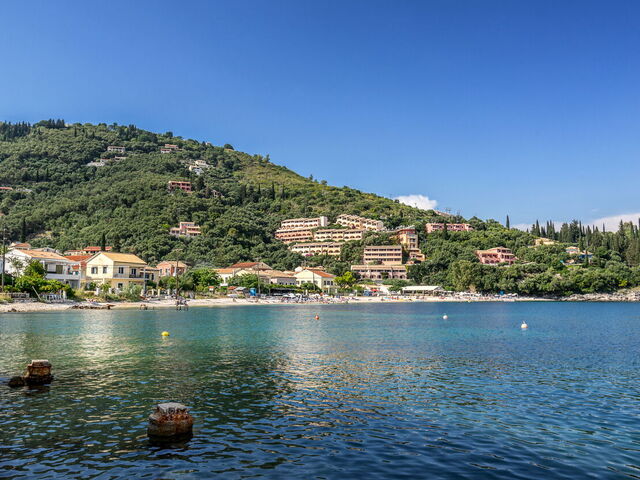
The Durrells is a magnificent TV series on air since 2017, produced by Sid Gentle Films and Masterpiece and which made the whole world discover the beauties of a Corfu of the past, when there were still no holiday villages, discos and luxurious clubs on the beaches of the island.
The series is in fact set starting from 1935, when an entire family with British origins decides to change their lives and move to Corfu. The progenitor of the Durrells, however, died during the war, so Louisa, the mother, has to face a series of events that take place between the tragedy and the comedy together with her children and the inhabitants of the island, still unaccustomed to foreigners.
Did you know the Durrells really existed? The Durrells, indeed, is the television reinterpretation of the trilogy of autobiographical books "My Family and Other Animals Birds", "Beasts, and Relatives" and "The Garden of the Gods" written by the real Gerald Durrell, a British naturalist, zoologist and explorer who lived in Corfu with his family between 1935 and 1939. Compared to the book and fiction, however, the eldest son had already moved to Corfu with his wife a few years earlier and was then joined from his family.
The house where the daily life scenes of the Durrells are filmed has become a tourist spot and is known as the "White House" of the Bay. It still exists and is super requested to stay!
The locations on the island where the series was filmed are mainly Kalami, Agni Beach, Corfu Town and Danilia, all located in the northern part of Corfu.
If you want to spend a stay in the same locations as the Durells, take a look at our Villas in Corfu as Villa di Giovanni!
SEE OUR HOLIDAY RENTALS IN CORFU
CORFU
Corfu is the second largest island of the Ionian archipelago after Kefalonia. The island is known for its lively nightlife and its dream beaches, which frame the crystal clear water of the Ionian Sea. Few people know that it was under Venetian, French and English rule, before the island became part of Greece in 1864 and therefore hosts architectural examples attributable to each of its governments, making it a destination suitable for all types of travelers!
Its villages and its nature are certainly destinations to go to as an alternative to the aforementioned paradisiacal beaches.
Take a look at our travel tips and search for the right one for you!
Old Perithia: a Charming Ghost-town In Corfu.
Where To Stay In Corfu: 5 Travel Tips.
7 Beautiful Places You Need To See In Corfu.
Read More
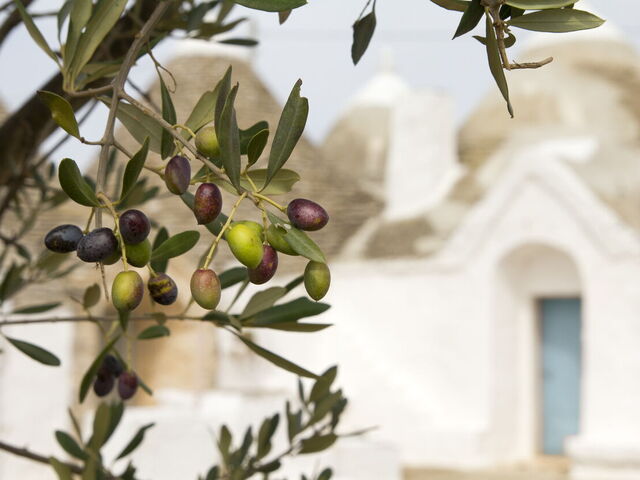
Puglia: the heel of the Italian peninsula, where histories, cultures, and civilizations have come together since antiquity to create one-of-a-kind traditions. Puglia’s territory and location have cultivated a rich diversity of farming, animal husbandry and fishing. The resulting dishes are simple—and simply delicious—examples of the renowned Mediterranean diet. Grains, legumes, fresh vegetables and fish take center stage, as well as delicious desserts that are adored by visitors to this splendid region.
Let’s discover the top 10 traditional dishes from Puglia, and get ready for our next food and wine tour!
1. Orecchiette e cime di rapa: Orecchiette pasta with broccoli rabe
Handmade by skilled pasta artisans, this one-of-a-kind pasta is called “little ears” for its ear-like shape. There are many different sauces and gravies used with orecchiette, but the most delicious and famous is broccoli rabe sautéed with anchovy filets to lend incredible flavor to the whole dish! It’s impossible to resist a second helping, which you will surely be offered.
2. Polpette di pane: Bread fritters
Bread fritters are a homemade specialty of southern Italian mothers and grandmothers, in the tradition of frugal housekeeping. Nothing goes to waste! Egg, parsley and other herbs are added to stale bread soaked in milk, then the batter is fried until crispy and delicious. Fresh out of the oil, enjoyed while waiting for lunch, they are the perfect finger food!
3. Pasticciotto
An authentic breakfast in Lecce isn’t complete without pasticciotto: a flaky pastry shell filled with custard. Nothing more, nothing less, but the pasticciotto’s simplicity is what makes it irresistable. Legend has it that pasticiotto was the result of a pastry chef’s mistake in the 1700s. When he didn’t have enough ingredients for an entire cake, the chef decided to make a small dessert instead, and pasticiotto was born. It’s available in all bars and pastry shops, and not just at breakfast, so you can indulge at any time of day!
4. Cozze arraganate: Baked mussels
These mussels from the province of Taranto are the most delicious in Puglia! They are stuffed with egg, parsley and cheese, then broiled in the oven: a succulent and original way to eat Italy’s most delicious mussels. You can find them in any restaurant along the coast of Taranto, as well as in the area of Salento.
5. Focaccia barese: Bari-style focaccia
Soft, thick dough with crunchy edges and just the right amount of oil. Sweet cherry tomatoes and oregano top this focaccia, which has become the symbol of Puglia street food. It’s as famous as the pizza of Naples, but seldom made in other regions because frankly it’s one of a kind! Bari-style focaccia can be found hot out of the oven at bakeries and takeaway shops, not just in Bari, but all over Puglia!
6. Melanzane ripiene: Stuffed eggplant
The pride of homecooks, each with their own recipe: the recipe for stuffed eggplant is simple, but the flavor evokes Sundays with family. Whole eggplant skins, cut in half, are stuffed with eggplant flesh cooked in plenty of oil and tomato, mixed with cheese, sometimes meat, breadcrumbs and plenty of love. Baked in the oven until golden and voilà: it’s a simply exquisite dish.
7. Panzerotti
Fried in boiling oil, panzerotti are Puglia’s specialty! These half-moons filled with tomato, mozzarella and anchovies are a must for foodies and the perfect alternative to a simple sandwich. There is a wide variety of creative and refined fillings to please all palates. So bring on the fillings with cured meats, cheeses, vegetables and delicious sauces. Don’t miss out!
8. Cartellate
The one and only holiday treats: cartellate! Their traditional rose shape resembles baby Jesus’s crown. Cartellate are made from a simple dough of flour and white wine, and then they are, of course, fried. After cooking, honey or vincotto are added according to individual taste and the cook’s recipe. Don’t turn your back or they’ll be gobbled up before you know it!
9. Friselle
During the hot summer, friselle are the key to a light and fresh lunch between a dip in the sea and your afternoon nap. Also called frise, friselle are made from an O-shaped roll that’s divided in half and toasted. Friselle are soaked in water according to taste, topped with oil and rubbed with cherry tomatoes just like normal bruschetta. And don’t forget oregano, the omnipresent herb of Puglia cuisine. Recently, gourmet friselle have also become popular, with burrata, anchovies and pesto, as well as salmon and avocado!
10. Fave e cicorie: Fava beans and chicory
Last but not least: the real tradition from inland Puglia, made from simple, wholesome ingredients by humble farmers. Fava beans and chicory is not just a dish, it’s an aroma, an emotion, the feeling of home and wholesomeness. Dried white fava beans are cooked for hours until they soften into a puree, and chicory from the fields is lightly sauteed. They come together on the plate and are topped with a simple drizzle of oil. It’s a dish that will stir your emotions by taking you back in time.
There are many more traditional dishes in the small but incredibly diverse region of Puglia. To discover them all your only choice is to go try them in person! For a fantastic vacation in Puglia tasting the region’s specialties, we recommend staying in one of our vacation villas in Puglia like Trullo Santo Stefano, Meadow Luxury Villa!
Read More
Ibiza: the paradise in the heart of the Mediterranean sea where you can spend unforgettable nights dancing to the beats of world famous DJs, and enjoy long sunsets on golden beaches with your friends.
But are nightclubs, beaches and fun all that this marvelous island has to offer?
There’s even more than the crystal clear waters and nightlife! Discover inland Ibiza, with its small towns and villages suspended in time in the midst of the stark, wild landscape. Inland Ibiza’s authentic charm lies in the people who live there, away from the crowds. Over the centuries, they have protected their traditions and customs, as well as the art and architecture that can be found only in their villages.
Let’s discover inland Ibiza towns that are well worth a visit!
Sant Mateu d’Albarca
World renowned for its exquisite wine and characteristic Ibizan style San Mateu d’Albarca is a small, unspoilt town inland not far from the coast. Immersed in the countryside dotted with fields of fruit, the village offers unimaginable calm and tranquility. If you visit Sant Mateu d’Albarca in the winter, don’t miss the annual Wine Festival held in December. Just 18 kilometers from the city of Eivissa, it is a must for culture lovers.
Sant Carles de Peralta
It’s true that this village is on the coast, but it’s the outskirts that will enchant you! Sant Carles de Peralta is considered a miniature Ibiza, mainly because it has preserved island characteristics like old venues that have remained the same since the ‘60s, Mediterranean vegetation and few inhabitants during the low season.
Don’t miss the Las Dalias hippy market, with hundreds of stalls where you can find precious souvenirs and characteristic white embroidered dresses, as well as handcrafted objects and Gypsy style jewelry. If you love fashion and are always looking for the perfect, one-of-a-kind item to remember your vacation, Las Dalias market in Sant Carles de Peralta is for you. The market is open year round every Saturday from 10 am to 8 pm, and also on Monday and Tuesday nights from June to September. In August it is open on Sundays as well, from 9 am to 1 am. There are also live concerts and Namastè events!
Santa Gertrudis de Fruitera
This is where thousands of artists from all over Europe found refuge during the ‘60s and ‘70s. In fact, here they organized art galleries and workshops, and bartered art for food with the locals. There are still traces of this unusual exchange at the famous Bar Costa, where splendid paintings are hung among hams.
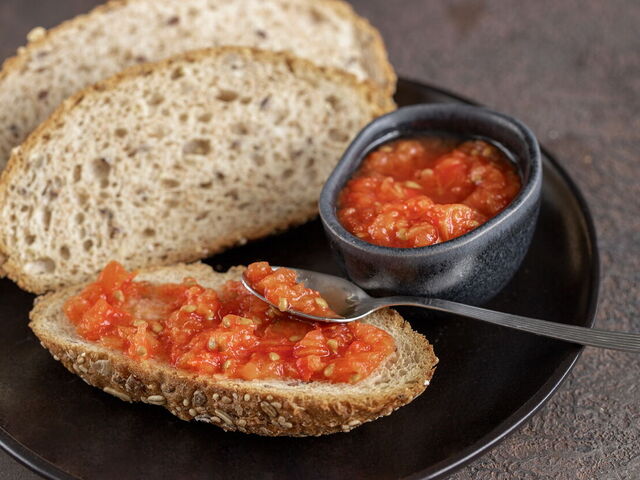
The village itself is very calm, and also known for its Pan amb tomaquet, or bread with tomato, which you can eat at the bars or various terraces in town.
Santa Gertrudis de Fruitera is another spot not to be missed! Its church, built at the end of the 1700s, has a splendid white facade in characteristic Ibizan style, but with colorful touches. It is one of a kind!
If you would like to visit marvelous inland Ibiza and explore splendid, authentic villages that offer utmost relaxation, take a look at our Villas in Ibiza, like Villa Savonne, Can Pegaso Grande and Blakstand San Rafael.
Read More
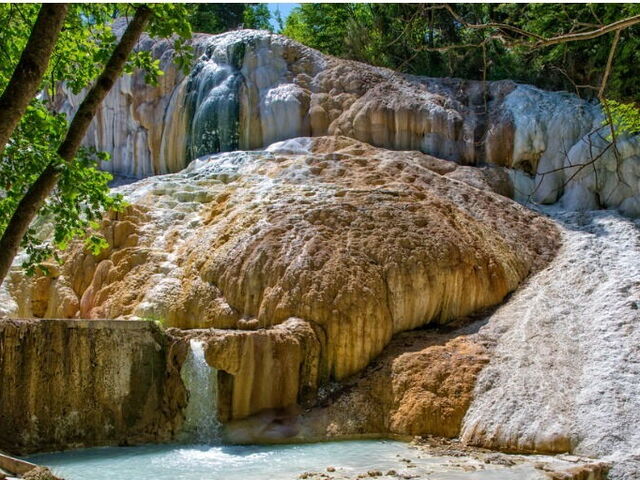
What could be better than relaxing in a beautiful thermal bath in the midst of nature? And what if I told you that there are magnificent natural hot springs scattered around Tuscany that can be enjoyed free of charge?
Well hidden among the Tuscan hills, these natural hot springs are the stuff of dreams. The surrounding wilderness, the peace and quiet in spring and autumn, the health benefits of the warm waters: don’t miss out on the one-of-a-kind experience that only hot springs can offer!
If you are looking for a relaxing spot to spend the entire day, even during the colder months, here is a selection of the most beautiful and charming free, natural hot springs in Tuscany.
1) Terme di Petriolo
These splendid natural hot springs are immersed in Valle dell’Ombrone between the villages of Monticiano and Civitella Paganico. In the Roman era, their praises were sung by none other than Cicero himself.
Also known as Bagni di Petriolo, the springs were once a rest stop for the Medici and Gonzaga families. The 43°C waters are rich in substances that benefit both the body and spirit.
2) Terme di Saturnia
Perhaps the most famous and renowned in all of Tuscany, the Terme di Saturnia are ideal if you seek a beautiful place. It is accessible to everyone, with photogenic waterfalls that are very Instagrammable.
Legend has it that the god Saturn, irritated at human behavior, launched a lightning bolt that carved out the springs. The mortals were then able to calm their spirits in the spring’s warm waters.
A divine day in the pools is waiting for you!
3) Bagni di San Filippo
In the heart of the Val d’Orcia at the foot of Monte Amiata, the Bagni di San Filippo is one of the most incredible, relaxing spots in all of Tuscany. Over the years, calcium deposits have formed unforgettable white walls and cascades (called Fosso Bianco and Balena Bianca)! Located in the wilderness, these springs are hard to reach, but the reward for your patience and spirit of adventure is an invigorating bath!
In addition to the splendid natural surroundings and hot waters, the beauty of thermal springs is that they are perfect for relaxing with friends, family, or on a couple’s vacation. If you are looking for a place to stay, take a look at our vacation villas near these marvelous hot springs, like Casale Santa Francesca and get ready for a unique, magical experience in Tuscany!
Read More
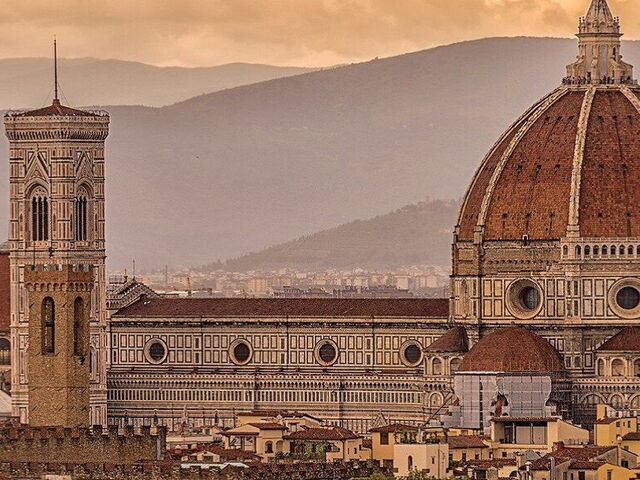
Florence is certainly one of the most beautiful cities in the world, rich in history, art and wonderful places. Before getting lost in the delightful streets of its historic center, why don't you try to see the city from another point of view? Florence offers numerous panoramic points from which you can admire breathtaking landscapes that will make you fall in love.
But what are the best scenic spots to see in Florence? Discover it by continuing to read this article!
Read More
October 22, 2020
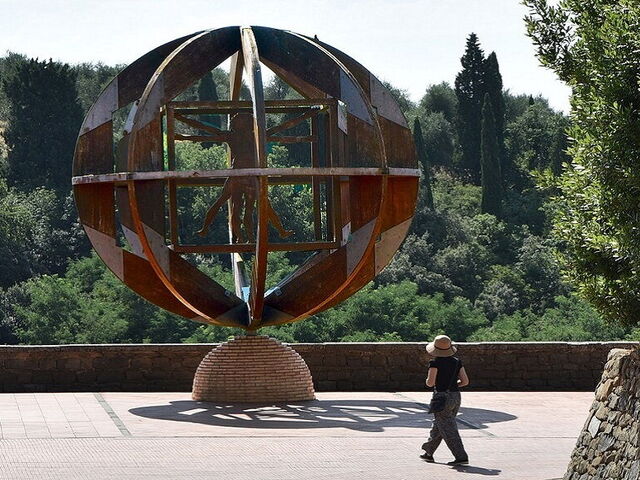
Leonardino Route: in the Footsteps of Leonardo da Vinci
Did you know that in the heart of Tuscany there is a wonderful nature trail that retraces the footsteps of Leonardo da Vinci?
Passing from Vinci, Anchiano and Montevettolini, which are the places where the artist spent his life, the Leonardino path was inspired by a drawing made by Leonardo in 1473, which depicted a view from the oratory of Santa Maria della Neve in Montevettolini.
There are two paths: one is called "the high path" and passes through the Montalbano ridge for a total of 17 kms, while the "low path" crosses the marshy area of the Padule and continues for a total length of 19 km. Passing through some of the most beautiful places in the Tuscan countryside, these paths allow you to discover hidden beauties and landscapes which are often ignored by popular itineraries. Ideal for people of all ages, they can be covered by foot in 5-6 hours or by mountain bike in 2-3 hours.
Would you like to know more? Discover more about the Leonardino road and start organizing your tour following the footsteps of the Tuscan genius!
The first route passes through some places of great historical value. It starts from Anchiano, where Leonardo's birthplace is located: he was born here on April 15, 1452 and the house remained in the possession of his until 1624. The road then continues towards Sant'Amato, it crosses the "Path of the Ancient Mills" and the remains of a wall of the Barco Reale, which is the name of a construction commissioned by the Medici Family to protect the game of Montalbano. Then, you arrive at Costareccia, the place where one of the family properties was located, and continue towards Orbignano. In this small village there is the Church of Santa Maria al Pruno, which preserves a wooden statue of the Madonna which was found abandoned in the midst of brambles after a theft, according to a legend. The route continues towards Lamporecchio, where you can visit the Pieve di Santo Stefano and see the marvelous terracotta altarpiece from 1524, made by Giovanni Della Robbia. Later, the route passes through Larciano, a village dominated by the tower of a fortress, as well as through the medieval village of Cecina, finally reaching Montevettolini. In this locality, the Medici built a villa in 1597 that dominates the whole valley!
The second route best enhances the natural beauties of the place and starts from Anchiano to continue towards the Church of Santa Lucia, which is considered Leonardo's place of baptism. From here, it continue towards the Torre di Sant’Alluccio, where the saint created a hospice for pilgrims during the Middle Ages and where you can also enjoy a splendid view of Valdarno and the plain of Pistoia. On the ridge road, there is also the Abbey of San Baronto, which was an important stopping place for Medieval pilgrims. You will also come across the remains of the Barco Reale, a wonderful hunting bandit commissioned by the Medici between the 16th and 17th centuries, where the game was raised and kept. The wall was interspersed with gates and today it is still possible to see one of the floodgates used for the flow of water. It is a splendid place that should not be missed! Other places you must see are the church of Santa Maria Assunta in Faltognano and the 17th century Cappella del Barco, which are located near this path. Finally, you reach Montevettolini , where you can fall in love with the beauty of the Medici Villa.
Are you ready for your itinerary retracing the steps of Leonardo da Vinci? Book now one of our properties near Vinci, such as Nicola, Il Sole di Vino and Villa Nora, and get ready to discover the beautiful places of Leonardo's life!
Read More
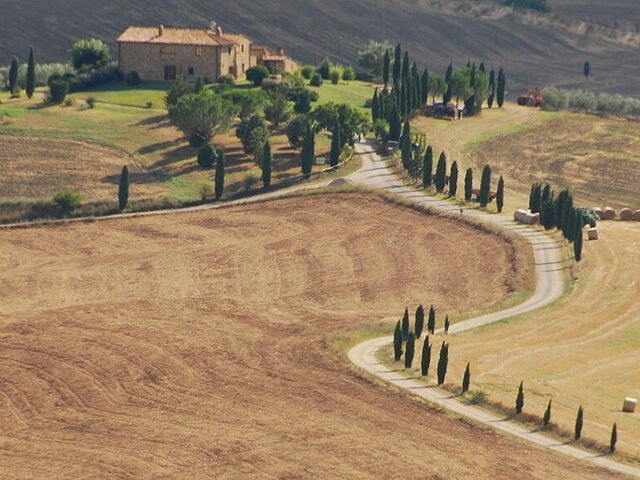
There are many reasons to visit Val d’Orcia: its landscapes, its history and its food specialties make tourists dream during their holiday in Tuscany. Maybe not everyone knows that this is also a perfect destination for cinema addicts! If you want to visit some locations of the most famous Hollywood films, an itinerary of cinema locations in Tuscany is what is right for you.
Many films have been shot in this region and each of them has underlined the beauty of the Tuscan countryside and villages.
Read more to discover which masterpieces have been filmed in Val d'Orcia and start planning your amazing tour!
Surely, one of the most successful films set in Val d'Orcia is Ridley Scott's "The Gladiator". The movie has been released 18 years ago, but it continues to enjoy an incredible success around the world, thanks to its excellent actors and the splendid
landscapes. The first scene shot in Val d'Orcia is the initial one, where two tragic deaths occur in the Gladiator's house. Do you remember the famous image of the hand stroking the wheat? Yes, it s taken from this part of the film! The second scene filmed here is the unforgettable finale, where the protagonist crosses a ripe wheat field to reunite with his family.
These two places can be easily found and visited by those who want to retrace the footsteps of the gladiator! The house is located in San Quirico d’Orcia: along the SP146 road that leads to Pienza, you will find on the left the gate of the Manzuoli farm. That's the entrance for the famous house! Instead, the landscape of the final scene is found in Pienza, at the end of a dirt road that descends from Pieve di Corsignano.
Another Oscar-winning film, "The English Patient" , was shot between Montepulciano and Pienza. The
protagonist, seriously injured, is treated in an abandoned convent near Pienza and stays in
Monastery of Sant’Anna in Camprena, which is currently a farmhouse. Most of the shooting
were carried out between Piazza Pio II in Pienza and the streets of Cosona, a fortified complex from the 1400s.
Many scenes from the film "Under the Tuscan Sun" were also shot between Montepulciano and Pienza, although the main location is the village of Cortona, located 30 km from Arezzo. In this movie, the landscape is both the protagonist and the magnificent scenery of the whole story!
Who hasn't seen a movie of the Twilight saga? Did you know that some scenes of "New Moon" were shot in Val d'Orcia? In the film, Edward Cullen decides to go visit the Volturi family in Volterra to end his life, as he believes that Bella is dead. However, "New Moon" was shot in Montepulciano and its Piazza Grande, because this location was more appreciated by the director.
Finally, we cannot forget to mention the great Tuscan director Franco Zeffirelli, who set his films "Romeo and Juliet" and "Brother sun sister moon" here. Walking along the main road of Pienza, you will plunge into the scenes of these famous films, imagining Juliet dancing in the courtyard of Palazzo Piccolomini and Mercuzio crossing Piazza del Duomo with Romeo. Instead, going to the Abbey of Sant’Antimo you will get immersed in one of the enchanting scenes of the film about Saint Francis
Are you ready to organize your itinerary to discover the locations of the best Hollywood movies? Book one of our properties in Val d'Orcia, like Villa San Michele and Casale Santa Francesca!
© Alice Pilastri
Read More
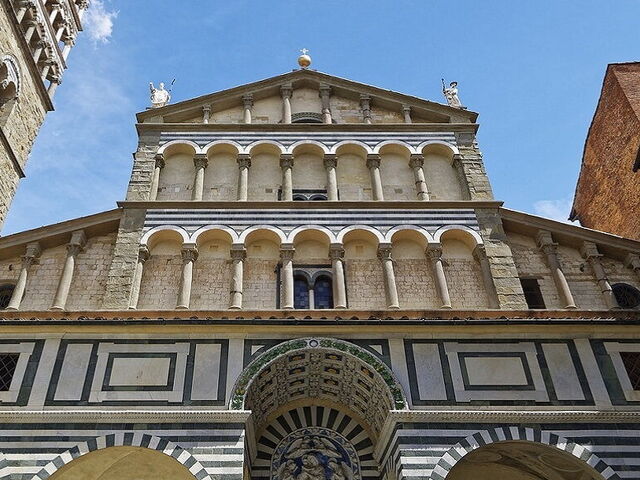
According to some, Pistoia is like a "little Florence" with an enormous amount of art and beauty inside. Although it is less known than other cities such as Pisa or Lucca, Pistoia is a delightful center where you can stroll in peace, admiring amazing monuments and the architectural traces of a flourishing past. Observing the medieval palaces, the main squares and the lovely buildings, you can retrace the history of the city and discover its smallest details. Fall in love with every glimpse of this stunning Italian town!
If you love nightlife, art and the charm of small Tuscan centers, Pistoia is the ideal destination for you! It is located halfway between Pisa and Florence and is the perfect place to have a holiday in Tuscany.
But what are the best things to see in Pistoia? Read on and discover the list of the most beautiful attractions you can find in this city!
1. Cathedral of San Zeno and Piazza del Duomo
Piazza del Duomo is certainly the center of city life. The main monument is the Cathedral of San Zeno, a building erected on Roman ruins which is also the oldest building in Pistoia. The Cathedral was built in the Middle Ages, but it only acquired its present appearance in the 14th century. The magnificent marble facade is made of white and green serpentine marble and features columns, arches and artistic decorations.
2. Battistero di San Giovanni
The baptistery of San Giovanni is located in the center of Piazza del Duomo and has a charming Gothic style, with decorations in white and green marble. It has an octagonal plan and is covered with a dome frescoed by the famous artist Andrea Pisano. Inside the baptistery, it is also possible to admire a baptismal font from the 13th century.
3. Piazza della Sala
While Piazza del Duomo can be considered the artistic and historical center of the city, Piazza della Sala is certainly the commercial and social spot. It is one of the oldest squares, where the city market has been taking place for centuries. In the morning, the square is filled with the voices and noises of those who go to the market to shop, while in the afternoon the atmosphere is pleasant and quiet. During the night, the square comes alive with hundreds of people flocking to its bars to have an aperitif or to meet their friends!
4. Palazzo del Comune
Palazzo del Comune is the seat of political power in Pistoia, which has resided there since 1294. The building was completed in 1348 and is also known as Palazzo di Giano, the name of the Podestà who commissioned its construction. The plan of the building is rectangular and the austere facade has important arches with mullioned windows and three-mullioned windows. It is an impressive building that today houses the beautiful Municipal Museum, full of Italian works of art created between 1200 and 1800.
.
5. Ospedale del Ceppo
The ancient Ospedale del Ceppo is located in Piazza Giovanni XXIII and was founded in the 13th century, when it played an important role for the community during the period of the Black Plague. The beautiful facade has many decorations, some of which are made by Benedetto Buglioni and Giovanni della Robbia, two famous terracotta decorators in Italy. Its frieze is, in fact, very famous: the beautiful scenes portray the theological and cardinal virtues and shed light on the theme of assistance and Mercy.
6. The Zoo of Pistoia
The Pistoia zoological garden is a must! The zoo is home to an incredible variety of animals, which come from all over the world. It is a unique place to introduce the little ones to new exotic breeds and to spend a pleasant afternoon with their family! It is located only 15 minutes from the center of Pistoia and is certainly one of the most fun places to discover with children.
Are you looking for a holiday home for rent near Pistoia? Discover more about Antico Fienile, one of our beautiful properties for rent near Pistoia!
© Alice Pilastri
Read More